


Page 80 - ESAM-1-2
P. 80
Engineering Science in
Additive Manufacturing Porous structure performance improvement
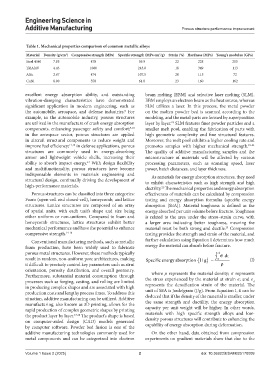
Table 1. Mechanical properties comparison of common metallic alloys
.
Material Density (g/cm ) Compressive strength (MPa) Specific strength (MPa cm /g) Strain (%) Hardness (MPa) Young’s modulus (GPa)
3
3
Steel 4340 7.85 470 59.9 22 228 205
Ti6Al4V 4.43 1080 243.8 18 349 113
AlSc 2.67 474 107.5 20 115 72
CuNi 8.90 550 61.8 23 160 162
excellent energy absorption ability, and outstanding beam melting (EBM) and selective laser melting (SLM).
vibration-damping characteristics have demonstrated EBM employs an electron beam as the heat source, whereas
significant application in modern engineering, such as SLM utilizes a laser. In this process, the metal powder
the automobile, aerospace, and defense industries. For on the molten powder bed is scanned according to the
8
example, in the automobile industry, porous structures modeling, and the metal parts are formed by superposition
are utilized in the manufacture of crash energy absorption layer by layer. SLM features finer powder particles and a
18
components, enhancing passenger safety and comfort; smaller melt pool, enabling the fabrication of parts with
9,10
in the aerospace sector, porous structures are applied high geometric complexity and fine structural features.
in aircraft structural components to reduce weight and Moreover, the melt pool exhibits a higher cooling rate and
improve fuel efficiency; 11,12 in defense applications, porous promotes samples with higher mechanical strength. 19-21
structures are commonly used in energy-absorbing The quality of additive manufacturing samples and the
armor and lightweight vehicle shells, increasing their microstructure of materials will be affected by various
ability to absorb impact energy. With design flexibility processing parameters, such as scanning speed, laser
13
and multifunctionality, porous structures have become power, hatch distances, and layer thickness.
indispensable elements in materials engineering and As materials for energy absorption structures, they need
structural design, continually driving the development of to exhibit characteristics such as high strength and high
high-performance materials.
22
ductility. The mechanical properties and energy absorption
Porous structures can be classified into three categories: effectiveness of materials can be calculated by compression
Foam (open-cell and closed-cell), honeycomb, and lattice testing and energy absorption formulas (specific energy
structures. Lattice structures are composed of an array absorption [SEA]). Material toughness is defined as the
of spatial units, with each unit’s shape and size being energy absorbed per unit volume before fracture. Toughness
either uniform or non-uniform. Compared to foam and is related to the area under the stress–strain curve, with
honeycomb structures, lattice structures exhibit better a larger area indicating better toughness, meaning the
mechanical performance and have the potential to enhance material must be both strong and ductile. Compression
23
compressive strength. 14-16 testing provides the strength and strain of the material, and
Conventional manufacturing methods, such as metallic further calculation using Equation I determines how much
foam production, have been widely used to fabricate energy the material can absorb before fracture.
porous metal structures. However, these methods typically d σ d
result in random, non-uniform pore architectures, making Specific energy absorption J g / ( ) = ∫ 0 (I)
it difficult to precisely control key parameters such as strut ρ
orientation, porosity distribution, and overall geometry. where represents the material density; represents
Furthermore, substantial material consumption through the stress experienced by the material at strain ; and
processes such as forging, casting, and rolling are limited d
in producing complex shapes and are associated with high represents the densification strain of the material. The
production costs and lengthy process times. To address this unit of SEA is Joule/gram (J/g). From Equation I, it can be
situation, additive manufacturing can be utilized. Additive deduced that if the density of the material is smaller, under
manufacturing, also known as 3D printing, allows for the the same strength and ductility, the energy absorption
rapid production of complex geometric shapes by printing capacity per unit weight will be higher. In other words,
the product layer by layer. 17,18 The product’s shape is based materials with high specific strength alloys and low-
on computer-aided design (CAD) models generated density porous structures will contribute to enhancing the
by computer software. Powder bed fusion is one of the capability of energy absorption during deformation.
additive manufacturing technologies commonly used for On the other hand, data obtained from compression
metal components and can be categorized into electron experiments on gradient materials show that due to the
Volume 1 Issue 2 (2025) 2 doi: 10.36922/ESAM025170009

