


Page 81 - ESAM-1-2
P. 81
Engineering Science in
            Additive Manufacturing                                            Porous structure performance improvement


            layered pore distribution in gradient materials, the material   strut diameter can rapidly increase the volume fraction,
            collapses layer by layer during the collapse process instead   and the porosity of the structure will decrease to achieve
            of immediately fracturing along the direction of maximum   the desired mechanical properties. The influence of the
            shear force at approximately 45° from top to bottom. In   optimized radius on the volume fraction is presented in
            addition, during the collapse process, densification stacking   the stiffness and strength of the material structure, both of
            occurs, resulting in a higher area under the stress–strain   which are significantly enhanced. 26
            curve for gradient materials compared to uniform density;   When a material is subjected to perpendicular strength,
            this characteristic provides better energy absorption for   it may undergo deformation, which can be classified into
            gradient materials. 23-25                          two types: “bending” and “buckling.” Bending occurs due
              In additive manufacturing, products made by SLM   to the strain behavior induced in the material by strength
            typically exhibit a very rough surface, often with many   applied perpendicular to its principal axis, whereas
            incompletely melted powders adhering to the surface. From   buckling refers to a sudden change in the shape of the
            a microscopic perspective, when subjected to an external   material when axial strength reaches a critical level. 31-33
            force, stress concentrates at the tip of cracks. Cracks with   This  study  focuses  on  the  relationship  between  material
            smaller curvature radius and deeper notches experience   strength and Young’s modulus by exploring the effects of
                                                                                                            34
            a rapid increase in strength, causing them to withstand   buckling and bending deformations of struts. Zhao et al.
            greater strength than other locations. Consequently, they   conducted with Cubic, G7, and Rhombic dodecahedron.
            are  more  likely  to  exceed  the  yield  strength  and  plastic   The  results  indicate  that  the  Cubic  structure  mostly
            deformation  that  happened  earlier.  This  phenomenon   fractures due to compressive strength, mainly compressed
            initiates the propagation of cracks from pre-existing flaws,   by perpendicular buckling struts. On the other hand, for
            resulting in material fracture, accompanied by a decrease   the G7 and Rhombic dodecahedron structures, strength
            in both strength and ductility.  Stress concentration can be   is mainly compressed by bending struts under tension
                                   26
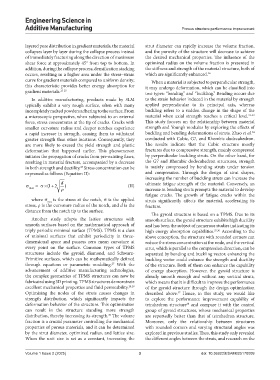
            expressed as follows (Equation II):                and compression. Through the design of  strut shapes,
                                                               increasing the number of buckling struts can increase the
                           d                                   ultimate fatigue strength of the material. Conversely, an
            σ max  =  σ ×( 1 2+  ρ )                   (II)    increase in bending struts prompts the material to develop
                                                               fatigue cracks. The growth of fatigue cracks within the
              where σ   is the stress at the notch, σ is the applied   struts  significantly affects the  material,  accelerating its
                     max
            stress, ρ is the curvature radius of the notch, and d is the   fracture.
            distance from the notch tip to the surface.
                                                                 The gyroid structure is based on a TPMS. Due to its
              Another study adopts the lattice structures with   smooth surface, the gyroid structure exhibits high ductility
            smooth surfaces based on the mathematical approach of   and has been the subject of numerous studies indicating its
            triply periodic minimal surface (TPMS). TPMS is a class   high energy absorption capabilities. 35,36  According to the
            of minimal surfaces that exhibit periodicity in three-  above conception, the structure with rounded corners can
            dimensional space and possess zero mean curvature at   reduce the stress concentration at the node, and the vertical
            every point on the surface. Common types of TPMS   strut, which is parallel to the compression direction, can be
            structures include the gyroid, diamond, and Schwarz-  separated by bending and buckling vector, enhancing the
            Primitive surfaces, which can be mathematically defined   buckling vector could enhance the strength and ductility
                                                 27
            through equations or parametric modeling.  With the   of the structure. Both of them can enhance the capability
            advancement of additive manufacturing technologies,   of energy absorption. However, the gyroid structure is
            the complex geometries of TPMS structures can now be   already smooth enough and without any vertical struts,
            fabricated using 3D printing. TPMS structures demonstrate   which means that it is difficult to improve the performance
            excellent mechanical properties and fluid permeability. 28,29    of the gyroid structure through the design optimization
            Optimizing the nodes of the struts causes changes in   described above.  Hence, in this study, we would like
                                                                             37
            strength distribution, which significantly impacts the   to  explore  the performance  improvement  capability of
            deformation behavior of the structure. This optimization   tetrahedron structure  and compare it with the control
                                                                                38
            can result in the structure standing more strength   group of gyroid structures, whose mechanical properties
            distribution, thereby increasing its strength.  The volume   are reportedly better than that of tetrahedron structure.
                                               30
            fraction is a crucial parameter controlling the mechanical   Moreover,  only  the  relationship  between  structures
            properties of porous materials, and it can be determined   with rounded corners and varying structural angles was
            by the strut diameter, optimized radius, and lattice size.   explored in previous studies. Thus, this study only revealed
            When the unit size is set as a constant, increasing the   the different angles between the struts, and research on the


            Volume 1 Issue 2 (2025)                         3                          doi: 10.36922/ESAM025170009

