


Page 86 - ESAM-1-2
P. 86
Engineering Science in
            Additive Manufacturing                                            Porous structure performance improvement


            leading to fracture at that point, resulting in a lower yield   exhibit superior mechanical properties. Specifically, the
            strength of the overall structure than expected.   yield strength can reach up to a maximum of 26%, and the
                                                               compressive strength can reach up to 29%. In addition, they
            3.3. Impact of angle between the struts on         also demonstrate better energy absorption performance.
            mechanical properties                              Compared to the previous manipulation factor of rounded
            Figure 6 illustrates the stress–strain curves for structures   corners, structures with larger angles between the struts
            with different angles between the struts, whereas Table 4   show greater improvements in strength.
            compares the mechanical properties of structures with   When a tetrahedron is subjected to vertical compression,
            different support angles. According to the experimental   the strength along the strut can be divided into a buckling
            results, structures with larger angles between the struts
                                                               vector B and a bending vector D (Figure  11). Their
                                                               relationship with the strut angle  θ can be expressed by
                                                               Equations V and VI. Furthermore, the buckling vector can
                                                               be further divided into normal force N and lateral force
                                                               L (Figure  12). Their relationship with the strut angle  θ
                                                               can be expressed by Equations VII and VIII. Combining
                                                               Equations V and VI, they can be rearranged into Equations
                                                               IX and X.

                                                               B=F‧sin                                  (V)
                                                               D=F‧cos                                  (VI)
                                                               N=B‧sin                                 (VII)

                                                               L=B‧cos                                (VIII)
                                                               N=B‧sin2                                   (IX)
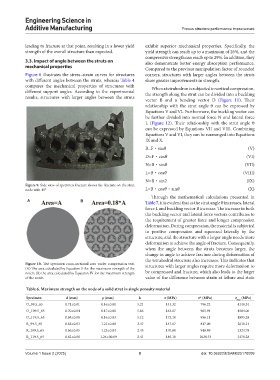
            Figure 9. Side view of specimen fracture shows the fracture on the strut
            node with 45°                                      L=B‧cos‧sin                             (X)
                                                                 Through the mathematical calculations presented in
             A                     B                           Table 7, it is evident that as the strut angle θ increases, lateral
                                                               force L and buckling vector B increase. The increase in both
                                                               the buckling vector and lateral force vectors contributes to
                                                               the requirement of greater force and longer compression
                                                               deformation. During compression, the material is subjected
                                                               to positive compression and squeezed laterally by the
                                                               structure, and the structure with a larger angle needs more
                                                               deformation to achieve the angle of fracture. Consequently,
                                                               when  the angle between  the struts  becomes  larger,  the
                                                               change in angle to achieve fracture during deformation of
                                                               the tetrahedral structure also increases. This indicates that
            Figure 10. Test specimen cross-sectional area under compression test.   structures with larger angles require more deformation to
            (A) The area calculated by Equation II for the maximum strength of the
            notch; (B) the area calculated by Equation IV for the maximum strength   be compressed and fracture, which also leads to the larger
            of the notch.                                      value of the difference between strain at failure and stain

            Table 6. Maximum strength on the node of a solid strut in single porosity material
            Specimen         d (mm)          ρ (mm)         k          σ (MPa)       σ* (MPa)        σ max  (MPa)
            O_99.5_65        0.71±0.01      0.16±0.01      5.21         143.32        796.22          4148.31
            O_109.5_65       0.70±0.04      0.17±0.01      5.06         163.07        905.94          4584.06
            O_119.5_65       0.68±0.06      0.16±0.03      5.12         172.10        956.11          4895.28
            R_99.5_65        0.65±0.03      1.21±0.08      2.47         147.07        817.06          2018.14
            R_109.5_65       0.66±0.05      1.25±0.04      2.45         170.80        948.89          2324.78
            R_119.5_65       0.62±0.06      1.24±00.09     2.41         185.10        1028.33         2478.28


            Volume 1 Issue 2 (2025)                         8                          doi: 10.36922/ESAM025170009

