


Page 88 - ESAM-1-2
P. 88
Engineering Science in
            Additive Manufacturing                                            Porous structure performance improvement


                         A                       B                      C


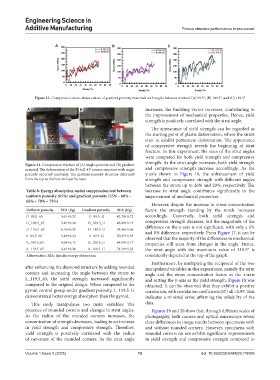
                Figure 13. Compressive stress–strain curves of gradient porosity materials with angles between struts of (A) 99.5°, (B) 109.5°, and (C) 119.5°

             A                     B                           increases,  the  buckling  vector  increases,  contributing to
                                                               the improvement of mechanical properties. Hence, yield
                                                               strength is positively correlated with the strut angle.
                                                                 The appearance of yield strength can be regarded as
                                                               the starting point of plastic deformation, where the struts
                                                               start to exhibit permanent deformation. The appearance
                                                               of compressive strength reveals the beginning of strut
                                                               fracture. In this experiment, the sizes of the strut angles
                                                               were compared for both yield strength and compressive
                                                               strength. As the strut angle increases, both yield strength
            Figure 14. Compression fracture of (A) single-porosity and (B) gradient
            material. The deformation of the Ti-6Al-4V porous structure with single   and compressive strength increase accordingly. As the
            porosity occurred randomly. The gradient-porosity structure deformed   y-axis shown in  Figure  16, the enhancement of yield
            from the top to the bottom layer by layer.         strength and compressive strength with different angles
                                                               between the struts up to 26% and 29%, respectively. The
            Table 8. Energy absorption under compression test between   increase in strut angle contributes significantly to the
            uniform porosity (65%) and gradient porosity (55% – 60% –   improvement of mechanical properties.
            65% – 70% – 75%)
                                                                 However, despite the increase in stress concentration
            Uniform porosity  SEA (J/g)  Gradient porosity  SEA (J/g)  factor, the strength standing by the notch increases
            O_99.5_65      5.01±0.22   O_99.5_G    42.78±0.72  accordingly. Conversely, both yield strength and
            O_109.5_65     5.45±0.36  O_109.5_G    48.89±1.13  compressive strength decrease, but the magnitude of the
            O_119.5_65     6.10±0.29  O_119.5_G    54.46±1.66  difference on the y-axis is not significant, with only a 6%
                                                               and 8% difference, respectively. From Figure 17, it can be
            R_99.5_65      5.49±0.32   R_99.5_G    50.97±1.33  observed that the majority of the differences in mechanical
            R_109.5_65     6.04±0.15   R_109.5_G   64.93±2.17  properties still stem from changes in the angle. Hence,
            R_119.5_65     6.61±0.26   R_119.5_G   71.56±1.22  the strut angle with the maximum value of 119.5° is
            Abbreviation: SEA: Specific energy absorption.     consistently depicted at the top of the graph.
                                                                 Furthermore, by multiplying the reciprocal of the two
            after enhancing the diamond structure by adding rounded   manipulated variables in this experiment, namely the strut
            corners and increasing the angle between the struts to   angle and the stress concentration factor, as the x-axis
            L_119.5_65, the yield strength increased significantly   and setting the y-axis as the yield strength, Figure 18 was
            compared to the original design. When compared to the   obtained. It can be observed that they exhibit a positive
            gyroid control group under gradient porosity, L_119.5_G   correlation, with correlation coefficients (R ) all >0.95. This
                                                                                                 2
            demonstrated better energy absorption than the gyroid.  indicates a minimal error, affirming the reliability of the
              This study manipulates two main variables: The   data.
            presence of rounded corners and changes in strut angles.   Figures 19 and 20 show that, through different scales of
            As  the  radius  of the  rounded  corners increases,  the   photography, both camera and optical microscope reveal
            concentration of strength decreases, leading to an increase   clear differences in image results between specimens with
            in yield strength and compressive strength. Therefore,   and without rounded corners. However, specimens with
            yield strength is positively correlated with the radius   rounded corners do not exhibit significant improvements
            of curvature of the rounded corners. As the strut angle   in yield strength and compressive strength compared to


            Volume 1 Issue 2 (2025)                         10                         doi: 10.36922/ESAM025170009

