


Page 82 - ESAM-1-2
P. 82
Engineering Science in
            Additive Manufacturing                                            Porous structure performance improvement


                          A                      B                         C


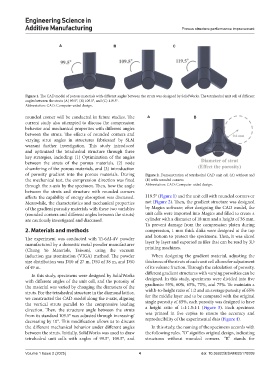
            Figure 1. The CAD model of porous materials with different angles between the struts was designed by SolidWorks. The tetrahedral unit cell of different
            angles between the struts (A) 99.5°, (B) 109.5°, and (C) 119.5°.
            Abbreviation: CAD: Computer-aided design.

            rounded corner will be conducted in future studies. The   A            B
            current study also attempted to discuss the compression
            behavior and mechanical properties with different angles
            between the struts. The effects of rounded corners and
            varying strut angles in structures fabricated by SLM
            warrant further investigation. This study introduced
            and optimized the tetrahedral structure through three
            key strategies, including: (1) Optimization of the angles
            between the struts of the porous materials, (2) node
            chamfering of the porous materials, and (3) introduction
            of porosity gradient into the porous materials. During   Figure 2. Demonstration of tetrahedral CAD unit cell (A) without and
            the mechanical test, the compression direction was fixed   (B) with rounded corners
            through the z-axis by the specimen. Then, how the angle   Abbreviation: CAD: Computer-aided design.
            between the struts and structure with rounded corners
            affects the capability of energy absorption was discussed.   119.5° (Figure 1) and the unit cell with rounded corners or
            Meanwhile, the characteristics and mechanical properties   not (Figure 2). Then, the gradient structure was designed
            of the gradient porosity materials with these two variables   by Magics software; after designing the CAD model, the
            (rounded corners and different angles between the struts)   unit cells were imported into Magics and filled to create a
            are cautiously investigated and discussed.         cylinder with a diameter of 18 mm and a height of 36 mm.
                                                               To prevent damage from the compression platen during
            2. Materials and methods                           compression, 1 mm thick disks were designed at the top
                                                               and bottom to protect the specimens. Then, it was sliced
            The experiment was conducted with Ti-6Al-4V powder   layer by layer and exported as files that can be read by 3D
            manufactured by a domestic metal powder manufacturer
            (Chung  Yo  Materials, Taiwan),  using  the  vacuum   printing machines.
            induction gas  atomization  (VIGA)  method.  The  powder   When designing the gradient material, adjusting the
            size distribution was D10 of 27 m, D50 of 38 m, and D50   thickness of the struts of each unit cell allows for adjustment
            of 49 m.                                           of its volume fraction. Through the calculation of porosity,
              In this study, specimens were designed by SolidWorks   different gradient structures with varying porosities can be
            with different angles of the unit cell, and the porosity of   designed. In this study, specimens were divided into five
            the material was varied by changing the diameters of the   gradients: 55%, 60%, 65%, 70%, and 75%. To maintain a
            struts. For the tetrahedral structure in the diamond lattice,   width-to-height ratio of 1:2 and an average porosity of 65%
            we constructed the CAD model along the z-axis, aligning   for the middle layer and to be compared with the original
            the  vertical  struts  parallel  to  the  compressive  loading   single porosity of 65%, each porosity was designed to have
            direction. Then, the structure angle between the struts   a height ratio of 1:1:1.5:1:1 (Figure  3). Each specimen
            from its standard 109.5° was adjusted through increasing/  was printed in five copies to ensure the accuracy and
            decreasing by 10°. This modification allows us to discuss   reproducibility of the experimental data (Figure 4).
            the different mechanical behavior under different angles   In this study, the naming of the specimens accords with
            between the struts. Initially, SolidWorks was used to draw   the following rules. “O” signifies original design, indicating
            tetrahedral unit cells with angles of 99.5°, 109.5°, and   structures without rounded corners. “R” stands for


            Volume 1 Issue 2 (2025)                         4                          doi: 10.36922/ESAM025170009

