


Page 70 - IJAMD-1-1
P. 70
International Journal of AI
            for Material and Design                                           Machine learning for gripper state prediction


            research offers an in-depth examination of the gripper’s   a cable-driven approach involving a motor and strings for
            physical  behavior  under  different  actuation  scenarios,   movement activation. Notably, the cable was strategically
            systematically overcoming the challenges of modeling   positioned off-center from the joint to generate a bending
            soft materials and complex joint interactions. Besides,   moment when tensioned.
            this work illustrates the potential of machine learning in   The finger’s architecture incorporated a variety of
            bridging the gap between theoretical models and practical   materials, such as TPU and c-PLA, each fulfilling distinct
            applications, thus pushing the boundaries of what can be   roles. Predominantly made of TPU, the finger was designed
            achievable in soft robotics.                       to interact gently with objects, reducing the risk of damage
            2. Methods                                         during gripping. The c-PLA material serves a dual purpose:
                                                               it functions as the structural backbone, which supports
            2.1. Design of the gripper with stiffness-tunable   significant loads and facilitates variable joint stiffness when
            joints                                             subjected to heat.
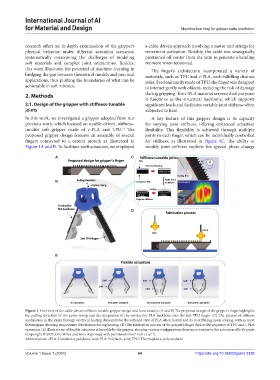
            In this work, we investigated a gripper adopted from our   A key feature of this gripper design is its capacity
            previous work, which focused on a cable-driven, stiffness-  for varying joint stiffness, offering enhanced actuation
                                                     13
            tunable soft gripper made of c-PLA and TPU.  The   flexibility. This flexibility is achieved through multiple
            proposed gripper design features an assembly of several   joints in each finger, which can be individually controlled
            fingers connected to a central mount, as illustrated in   for  stiffness,  as  illustrated  in  Figure  1C.  The  ability  to
            Figure 1A and B. To facilitate swift actuation, we employed   modify joint stiffness exploits the special phase change

                         A                               C


                         B


                                                         D


                         E


            Figure 1. Overview of the cable-driven stiffness-tunable gripper design and functionality. (A and B) The proposed design of the gripper’s finger highlights
            the pulling direction of the nylon string and the integration of the conductive PLA backbone into the soft TPU finger. (C) The process of stiffness
            modulation in the joints through electrical heating demonstrates the softened state of PLA when heated and its re-stiffening upon cooling, with an inset
            thermogram showing temperature distribution during heating. (D) The fabrication process of the gripper’s finger depicts the sequence of TPU and c-PLA
            extrusion. (E) Illustrations of flexible actuation achievable by the gripper, showing various configurations from no actuation to the actuation of both joints
            (Copyright © 2023 John Wiley and Sons. Reprinted with permission from Goh et al. ).
                                                                 13
            Abbreviations: cPLA: Conductive polylactic acid; PLA: Polylactic acid; TPU: Thermoplastic polyurethane.

            Volume 1 Issue 1 (2024)                         64                      https://doi.org/10.36922/ijamd.2328

