


Page 75 - IJAMD-1-1
P. 75
International Journal of AI
            for Material and Design                                           Machine learning for gripper state prediction


            and consequent bending behavior. The criterion for   splits = 5 and n_repeats = 3, evaluated the performance
            splitting used is the mean squared error, with the best-split   of each machine learning algorithm, as described in
            approach used by the splitter. Optimal hyperparameters   Section 2.4, using mean absolute error (MAE) as the
            were determined through a grid search method, resulting   criterion to determine optimum hyperparameters. These
            in a maximum depth of 9, minimum sample splits of 1, and   data points were split into an 8:2 ratio for the training and
            a minimum sample in the leaf node of 2.            validation datasets in each iteration. The final model for
                                                               each algorithm was trained on the entire dataset with the
            2.4.3. K-nearest neighboring regression model      optimum hyperparameters. The accuracy of the best model

            K-nearest  neighbor regression was  chosen  for its   from the three algorithms was tested against an additional
            effectiveness in capturing intricate patterns in datasets   five new untrained test conditions (providing 10 data
            with complex interactions. KNN relies on the premise that   points with the two joint angles), in which the predicted
            similar input parameters yield similar output responses,   output from the model was simulated, and the resultant
            which is particularly relevant for our gripper model. In   joint angle was compared against the input to verify the
            this model, bending behavior was hypothesized to be   performance of the model.
            closely related to the specific configurations of stiffness
            and pull distance. KNN can adaptively predict the bending   3. Results and discussion
            angles by analyzing the “neighborhood” of data points   3.1. Analysis of the kinematics of the joint stiffness-
            with similar features, providing a form of instance-based   tunable gripper through numerical simulation
            learning that is highly adaptable to new data. Optimum
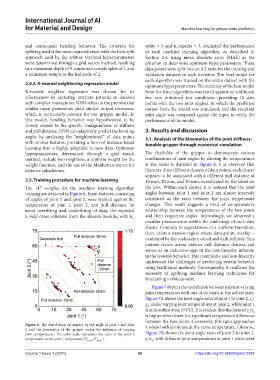
            hyperparameters, determined through a grid search   The flexibility of the gripper to demonstrate various
            method, include two neighbors, a uniform weight for the   combinations of joint angles by altering the temperatures
            weight function, and the use of the Manhattan metric for   at  the  joints  is  depicted  in  Figure  6.  It  is  observed  that
            distance calculations.                             there are three different clusters of data points; each cluster
                                                               appears to be associated with a different pull distance of
            2.5. Training procedure for machine learning       10 mm, 20 mm, and 30 mm, as indicated by the labels on
            The 147  samples for the machine learning algorithm   the plot. Within each cluster, it is noticed that the joint
            training are depicted in Figure 6. Input features, consisting   angles between joint 1 and joint 2 are almost inversely
            of angles of joint 1 and joint 2, were trained against the   correlated as the ratio between the joint temperature
            temperature of joint 1, joint 2, and pull distance. To   changes. This result suggests a kind of compensatory
            avoid overfitting and  underfitting of data, the  repeated   relationship between the temperatures of the two joints
            k-Fold cross validator from the sklearn module, with n_  and their respective angles. Interestingly, we observed a
                                                               peculiar phenomenon within the mid-range of each data
                                                               cluster. Contrary to expectations of a uniform transition,
                                                               there exists a narrow region where data points overlap –
                                                               evidenced by the coalescence of red and dark red dots. This
                                                               pattern  recurs  across  various  pull  distance  clusters  and
                                                               serves as an indicative sign of the non-linearity inherent
                                                               in the system’s behavior. This complexity and non-linearity
                                                               underscore the challenges of predicting system behavior
                                                               using traditional methods. Consequently, it reaffirms the
                                                               necessity of applying machine learning techniques for
                                                               forecasting in this context.
                                                                 Figure 7 depicts the correlation between joints at varying
                                                               joint temperatures with one of its joints at the softest state.
                                                               Figure 7A shows the joint angle ratio of joint 1 to joint 2, γ /
                                                                                                            1
                                                               γ , under varying joint temperatures at joint 2, while joint 1
                                                                2
                                                               is at its softest state (70°C). It is evident that the ratio of γ /γ 2
                                                                                                           1
                                                               is higher when there is a significant temperature difference
                                                               between the two joints. Conversely, this ratio approaches
            Figure 6. The distribution of samples by the angle of joint 1 and joint   1 when both joints are at the same temperature. Likewise,
            2 and the kinematics of the gripper under the influence of varying
            joint temperatures. The color scale represents the ratio of the joint 2   Figure 7B shows the joint angle ratio of joint 2 to joint 1,
            temperature to the joint 1 temperature (T Joint 2 /T Joint 1 ).  γ /γ , with different joint temperatures at joint 1 while joint
                                                                  2
                                                                1
            Volume 1 Issue 1 (2024)                         69                      https://doi.org/10.36922/ijamd.2328

