


Page 77 - IJAMD-1-1
P. 77
International Journal of AI
            for Material and Design                                           Machine learning for gripper state prediction


            complex heat transfer dynamics to more accurately reflect
            real-world conditions.                                                 Pull distance   10.0  10.0  20.0  20.0  30.0
            3.2. Prediction of joint angles using machine                            (mm)
            learning techniques
            The performance of every machine learning algorithm
            obtained from the cross-validation step is shown
            in  Figure  8A. Unsurprisingly, LR exhibits the worst               K‑nearest neighbors regression  Joint 2   temperature (°C)  70.0  47.5  62.5  67.5  62.5
            performance among the three algorithms, with the
            highest MAE for every predicted output. In contrast,
            KNN demonstrates the highest accuracy among the
            three algorithms. These results further support the earlier
            hypothesis that bending behavior is closely related to                 Joint 1   temperature (°C)  52.5  60.0  62.5  65.0  52.5
            the specific configurations of stiffness and pull distance.
            Notably, there is a significant improvement in the accuracy
            of pull distance prediction when using KNN instead of LR.
            The MAE is reduced from 0.71 ± 0.21 mm to 0.17 ± 0.27 mm,
            representing a 76% reduction in MAE. In comparison, the                Pull distance   (mm)  10.0  10.0  20.0  30.0  30.0
            MAE for the predicted output of the temperature of joint 1
            and joint 2 is reduced by 31% and 35%, respectively, from
            7.93 ± 1.55°C to 5.50 ± 1.85°C for joint 1 and 7.94 ± 1.52°C
            to 5.13 ± 1.68°C for joint 2. As depicted in Figure 8B, the            Joint 2   temperature (°C)  70.0  50.0  65.0  65.0  70.0
            Spearman correlation is remarkably high between the                 Decision tree regression
            joint angles and the pull distance compared to the other
            two outputs. This observation suggests that KNN is more
            effective in obtaining the targeted angle, as evidenced by
            a significant improvement in the MAE of pull distance.        Table 3. The required joint temperatures and the pull distance predicted by the trained linear regression, decision tree regression, and k‑nearest neighbors regression
            Meanwhile, the weak correlation score between the joint’s              Joint 1   temperature (°C)  60.0  60.0  65.0  60.0  60.0
            temperature and the joint’s angle may be attributed to the
            non-linear relationships between these variables.

              While the LR model exhibits the highest MAE among
            all three algorithms, it offers good explainability for the fit.       Pull distance   (mm)  10.9  9.5  22.7  22.6  29.6
            The fitted model is represented by these equations:

            Joint 1 temperature, y =52.95+0.28x -0.21x    (II)
                             0           1    2
            Joint 2 temperature, y =54.10-0.35x +0.33x  (III)                      Joint 2   temperature (°C)  59.9  55.2  54.4  58.4  56.2
                             1          1     2                                 Linear regression
            Pull distance, y =0.44+0.26x +0.26x        (IV)
                        2         1     2
              From the equations, it can be inferred that the required
            pull distance is longer when both joints are more bent. In
            addition, a  higher temperature  on joint 1 is needed for              Joint 1   temperature (°C)  48.8  53.5  56.0  51.7  54.8
            joint 1 to bend more than joint 2, and vice versa for the
            temperature on joint 2.
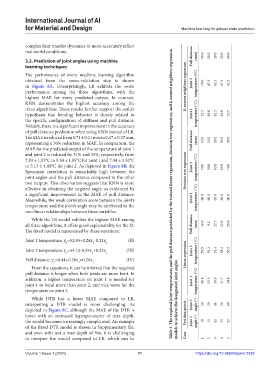
              While DTR has a lower MAE compared to LR,                     models to achieve the designated joint angles
            interpreting a DTR model is more challenging. As                       Joint 2   angle (°)  30  20  44  50  60
            depicted in Figure 8C, although the MAE of the DTR is
            lower  with  an  increased  hyperparameter  of  max  depth,         Test data points
            the model becomes increasingly complicated. An example                 Joint 1   angle (°)  10  15  42  35  52
            of the fitted DTR model is shown in Supplementary file,
            and even with just a max depth of five, it is challenging
            to interpret the model compared to LR, which can be                 Case    1  2  3  4  5


            Volume 1 Issue 1 (2024)                         71                      https://doi.org/10.36922/ijamd.2328

