


Page 72 - IJAMD-1-1
P. 72
International Journal of AI
            for Material and Design                                           Machine learning for gripper state prediction


            was designed to ascertain specific output parameters,   2.3. Numerical modeling and simulation of gripper
            specifically the angular displacement that resulted from   2.3.1. Modeling of gripper
            variations in the aforementioned input parameters.
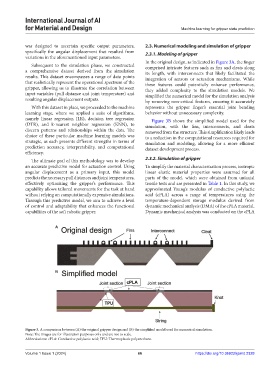
                                                               In the original design, as indicated in Figure 3A, the finger
              Subsequent to the simulation phase, we constructed   comprised intricate features such as fins and cleats along
            a comprehensive dataset derived from the simulation   its length, with interconnects that likely facilitated the
            results. This dataset encompasses a range of data points   integration of sensors or actuation mechanisms. While
            that realistically represent the operational spectrum of the   these features could potentially enhance performance,
            gripper, allowing us to illustrate the correlation between   they added complexity to the simulation models. We
            input variables (pull distance and joint temperature) and   simplified the numerical model for the simulation analysis
            resulting angular displacement outputs.            by removing non-critical features, ensuring it accurately
              With this dataset in place, we proceeded to the machine   represents the gripper finger’s essential joint bending
            learning stage, where we applied a suite of algorithms,   behavior without unnecessary complexity.
            namely linear regression (LR), decision tree  regression   Figure  3B shows the simplified model used for the
            (DTR), and k-nearest neighbor regression (KNN), to   simulation, with the fins, interconnects, and cleats
            discern patterns and relationships within the data. The   removed from the structure. This simplification likely leads
            choice of these particular machine learning models was   to a reduction in the computational resources required for
            strategic, as each presents different strengths in terms of   simulation  and  modeling,  allowing  for  a  more  efficient
            prediction accuracy, interpretability, and computational   dataset development process.
            efficiency.
              The ultimate goal of this methodology was to develop   2.3.2. Simulation of gripper
            an accurate predictive model for actuation control. Using   To simplify the material characterization process, isotropic
            angular displacement as a primary input, this model   linear elastic material properties were assumed for all
            predicts the necessary pull distances and joint temperatures,   parts of the model, which were obtained from uniaxial
            effectively optimizing the gripper’s performance. This   tensile tests and are presented in Table 1. In this study, we
            capability allows tailored movements for the task at hand   approximated Young’s modulus of conductive polylactic
            without relying on computationally expensive simulations.   acid (cPLA) across a range of temperatures using the
            Through this predictive model, we aim to achieve a level   temperature-dependent storage modulus derived from
            of control and adaptability that enhances the functional   dynamic mechanical analysis (DMA) of the cPLA material.
            capabilities of the soft robotic gripper.          Dynamic mechanical analysis was conducted on the cPLA


                         A


                         B


            Figure 3. A comparison between (A) the original gripper design and (B) the simplified model used for numerical simulation.
            Note: The images are for illustration purposes only and are not to scale.
            Abbreviations: cPLA: Conductive polylactic acid; TPU: Thermoplastic polyurethane.


            Volume 1 Issue 1 (2024)                         66                      https://doi.org/10.36922/ijamd.2328

