


Page 71 - IJAMD-1-1
P. 71
International Journal of AI
            for Material and Design                                           Machine learning for gripper state prediction


            characteristics of thermoplastic polymers, particularly their   actuation. The relationship between these factors is pivotal;
            capacity to soften under heat without breaking and then   a  joint with high stiffness counteracts  bending  with  a
            harden as they cool. For the backbone and joints, c-PLA is   greater moment, while a joint with lower stiffness offers
            selected for its electrically conductive properties. Stiffness   minimal resistance, allowing for a wider range of motion.
            modulation in the joints is accomplished through joule   Crucially, the stiffness of each joint is temperature
            heating, a technique where passing an electrical current   dependent, and the capability of adjusting this
            through a resistive material generates heat. In this design,   variable enables a virtually unlimited array of stiffness
            the carbon-infused c-PLA joints are heated by applying   configurations. This, in turn, translates into a myriad of
            electricity to each joint’s terminals. This heating reduces the   potential shapes and positions for the gripper, as illustrated
            joint’s stiffness, making it more pliable, the process reversed   in Figure 1E, each suited to different tasks and objects. The
            once the temperature falls back below the polymer’s glass   precise control of this variable is what imparts versatility
            transition point, as demonstrated in Figure 1C. The multi-  to the gripper. However, the sheer number of potential
            nozzle 3D printing process of the multimaterial gripper is   stiffness configurations presents a computational challenge.
            depicted in Figure 1D. By selectively heating various joints,
            different gripping configurations can be attained, enabling   Simulating and analyzing every possible combination of
            the gripper to conform to a range of geometrical shapes   joint stiffnesses and the resulting shapes of the gripper
            (Figure 1E).                                       would  be  infeasibly  resource  intensive.  To  address  this,
                                                               we integrated machine learning algorithms as a means to
            2.2. Development of a predictive model for the     circumvent the need for exhaustive numerical simulations,
            gripper with variable joint stiffness              providing a more resource-efficient approach to model the
                                                               gripper’s behavior.
            In this work, we investigated the dynamic behavior and
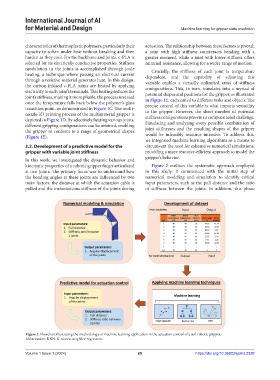
            kinematic properties of a robotic gripper finger articulated   Figure  2  outlines  the systematic  approach  employed
            at two joints. The primary focus was to understand how   in this study. It commenced with the initial step of
            the bending angles at these joints are influenced by two   numerical modeling and simulation to identify critical
            main factors: the distance at which the actuation cable is   input parameters, such as the pull distance and the ratio
            pulled and the instantaneous stiffness of the joints during   of stiffness between the joints. In addition, this phase


            Figure 2. Flowchart illustrating the methodology of machine learning application in the actuation control of a soft robotic gripper.
            Abbreviation: KNN: K-nearest neighbor regression.


            Volume 1 Issue 1 (2024)                         65                      https://doi.org/10.36922/ijamd.2328

