


Page 78 - IJAMD-1-1
P. 78
International Journal of AI
            for Material and Design                                           Machine learning for gripper state prediction


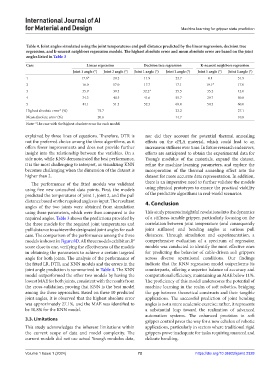
            Table 4. Joint angles simulated using the joint temperatures and pull distance predicted by the linear regression, decision tree
            regression, and k‑nearest neighbors regression models. The highest absolute error and mean absolute error are based on the joint
            angles listed in Table 3

            Case                      Linear regression       Decision tree regression  K‑nearest neighbors regression
                                Joint 1 angle (°)  Joint 2 angle (°)  Joint 1 angle (°)  Joint 2 angle (°)  Joint 1 angle (°)  Joint 2 angle (°)
            1                       17.6*        20.2         11.9          23.7         8.1          31.9
            2                       16.0         17.0         17.7          17.1         19.1*        17.0
            3                       35.9         39.3         32.2*         35.5         35.2         42.0
            4                       34.3         40.5         41.6          55.7         29.7         50.8
            5                       44.1         51.3         52.3          60.0         50.3         60.0
            Highest absolute error* (%)    75.7                             23.2                      27.1
            Mean absolute error (%)        20.6                             14.7                      10.8
            Note: *The case with the highest absolute error for each model.

            explained by three lines of equations. Therefore, DTR is   nor did they account for potential thermal annealing
            not the preferred choice among the three algorithms, as it   effects on the cPLA material, which could lead to an
            offers fewer improvements and does not provide further   increase in stiffness over time. In future research endeavors,
            insight into the relationship between the variables. On a   efforts are anticipated to obtain the experimental data for
            side note, while KNN demonstrated the best performance,   Young’s modulus of the materials, expand the dataset,
            it is the most challenging to interpret, as visualizing KNN   refine the machine learning parameters, and explore the
            becomes challenging when the dimension of the dataset is   incorporation  of  the  thermal  annealing  effect  into  the
            higher than 2.                                     dataset for more accurate data representation. In addition,
              The performance of the fitted models was validated   there is an imperative need to further validate the models
            using five new untouched data points. First, the models   using physical prototypes to ensure the practical viability
            predicted the temperatures of joint 1, joint 2, and the pull   of the predictive algorithms in real-world scenarios.
            distance based on the required angles as input. The resultant   4. Conclusion
            angles of the two joints were obtained from simulation
            using these parameters, which were then compared to the   This study presents insightful revelations into the dynamics
            required angles. Table 3 shows the predictions provided by   of a stiffness-tunable gripper, particularly focusing on the
            the three models for the required joint temperatures and   correlation between joint temperature (and consequently
            pull distance to achieve the designated joint angles for each   joint stiffness) and bending angles at various pull
            case. The comparison of the performance among the three   distances. Through simulation and experimentation, a
                                                          2
            models is shown in Figure 8D. All three models exhibit an R    comprehensive evaluation of a spectrum of regression
            score close to one, verifying the effectiveness of the models   models was conducted to identify the most effective ones
            in obtaining the parameters to achieve a certain targeted   for predicting the behavior of cable-driven soft grippers
            angle for both joints. The analysis of the performance of   across  diverse  operational  conditions.  Our  findings
            the fitted LR, DTR, and KNN models and the errors in the   indicate that the KNN regression model outperforms its
            joint angle prediction is summarized in Table 4. The KNN   counterparts, offering a superior balance of accuracy and
            model outperformed the other two models by having the   computational efficiency, maintaining an MAE below 11%.
            lowest MAE for both joints, consistent with the results from   The proficiency of this model underscores the potential of
            the cross-validation, proving that KNN is the best model   machine learning in the realm of soft robotics, bridging
            among the three approaches. Based on these 10 predicted   the gap between theoretical constructs and their tangible
            joint angles, it is observed that the highest absolute error   applications. The successful prediction of joint bending
            was approximately 27.1%, and the MAE was identified to   angles is not a mere academic exercise; rather, it represents
            be 10.8% for the KNN model.                        a substantial leap toward the realization of advanced
                                                               automation systems. The enhanced precision in soft
            3.3. Limitations                                   gripper control paves the way for a new echelon of robotic
            This study acknowledges the inherent limitations within   applications, particularly in sectors where traditional rigid
            the current scope of data and model complexity. The   grippers prove inadequate for tasks requiring nuanced and
            current models did not use actual Young’s modulus data,   delicate handling.


            Volume 1 Issue 1 (2024)                         72                      https://doi.org/10.36922/ijamd.2328

