


Page 30 - IJAMD-1-3
P. 30
International Journal of AI for
            Materials and Design
                                                                 Prediction of wall geometry for wire arc additive manufacturing


            Table 2. Results of bead and wall geometries (2% errors)
            V (V)      TS (mm/min)     BH (mm)     BW (mm)       TS (mm/min)    Dt (s)     H (mm)      W (mm)
            24             10            4.61         6.85           10           60        61.5        1.38
            24             5             6.46         7.82           5            60         63          2.3
            22             15            3.71         5.05           15           5          52          2.4
            24             15            3.31         6.25           15           60        56.8        1.32
            26             15            3.71         8.55           15          120         58         1.11
            24             5             7.2          8.01           5            60        62.8         2.2
            24             10            4,78         6.73           10           60         61         1.36
            26             10            4.51         7.91           10          120         62          1.4
            26             5             5.47         9.2            5           120         64         2.11
            22             5             6.52         6.25           5            5          59         2.98
            24             10            4.9          6.69           10           60        60.8        1.41
            26             10            4.51          8             10          120         61         1.44
            24             15            3.73         6.07           15           60        57.2        1.26
            22             10            4.51         5.98           10           5         57.4        1.88
            22             10            6.13         5.78           10           5         57.2        1.84
            Abbreviations: V: Voltage; TS: Travel speed; BH: Bead height; BW: Bead width; TS: Travel speed; Dt: dwell time; H: Height; W: Waviness.
            Statsmodels  for  statistical  modeling.  Ordinary  least   regression modeling and ANOVA, was adopted to acquire
            squares  regression  was  used  for  linear  modeling.  Scipy’s   in-depth insights regarding height and W for wall geometry
            minimize function was used for optimization tasks,   prediction. Incremental height was measured for each
            whereas Matplotlib was employed to create visualizations   bead following the design of experiments, using a distance
            for  result  interpretation.  The  collected  data  were  used   sensor  after  the  deposition of each layer.  This  approach
            to develop predictive models that helped establish the   was aimed at collecting data to guide the WAAM process,
            relationships between welding parameters and response   ultimately enhancing both quality and performance. The
            variables. Linear regression models were used to establish a   height and W of each layer were measured (data can be
            direct relationship between the predictors (V and TS) and   obtained from the authors upon request). Furthermore, all
            the response variables (BH and BW). Model performance   bead-on-plate samples were visually inspected and found
            was evaluated using metrics such as the mean squared   to be adequately fused and free of porosity or similar
            error (MSE) and coefficient of determination (R²) to   defects, thereby establishing the workable parameter range
            ensure accuracy and reliability. Subsequently, ANOVA   for our study.
            was employed to statistically assess the significance of each
            factor and their interactions. Notably, ANOVA compares   3. Results
            the variance explained by the model with the variance   3.1. BH and BW with a linear predictions
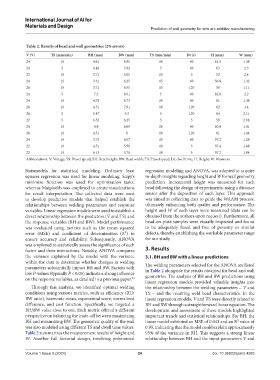
            within the data to determine whether changes in welding   The welding parameters selected for the ANOVA are listed
            parameters substantially impact BH and BW. Factors with   in Table 2 alongside the results obtained for bead and wall
            low P-values (typically P < 0.05) indicate a strong influence   geometries. The analysis of BH and BW predictions using
            on the response variables, as detailed in a previous paper. 33
                                                               linear regression models provided valuable insights into
              Through this analysis, we identified optimal welding   the relationship between the welding parameters – V and
            conditions using various metrics, such as efficiency (BH/  TS – and the resulting  weld bead characteristics. In  the
            BW ratio), harmonic mean, exponential score, normalized   linear regression models, V and TS were directly related to
            difference, and cost function. Specifically, we targeted a   BH and BW through a straightforward linear equation. The
            BH/BW value close to one. Each metric offered a different   development and assessment of these models highlighted
            perspective on balancing the trade-off between maximizing   important trends and statistical relationships. For BH, the
            BH and minimizing BW. The geometric quality of the wall   linear model exhibited an MSE of 0.043 and an R² value of
            was also modeled using different TS and dwell time values.   0.95, indicating that the model could explain approximately
            Table 2 summarizes the measurement results of height and   95% of the variance in BH. This suggests a strong linear
            W. Another full factorial design, involving polynomial   relationship between BH and the input parameters V and


            Volume 1 Issue 3 (2024)                         24                             doi: 10.36922/ijamd.4285

