


Page 33 - IJAMD-1-3
P. 33
International Journal of AI for
            Materials and Design
                                                                 Prediction of wall geometry for wire arc additive manufacturing


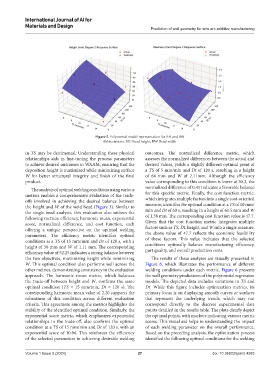
                                          Figure 5. Polynomial model representation for BH and BW
                                             Abbreviations: BH: Bead height; BW: Bead width.

            in TS may be detrimental. Understanding these physical   outcomes. The normalized difference metric, which
            relationships aids in fine-tuning the process parameters   assesses the normalized differences between the actual and
            to achieve desired outcomes in WAAM, ensuring that the   desired values, yields a slightly different optimal point at
            deposition height is maximized while minimizing surface   a TS of 5 mm/min and Dt of 120 s, resulting in a height
            W  for  better  structural  integrity  and  finish  of  the  final   of 64  mm and  W  of 2.11mm. Although the efficiency
            product.                                           value corresponding to this condition is lower at 30.3, the

              The analysis of optimal welding conditions using various   normalized difference of 0.41 indicates a favorable balance
            metrics enables a comprehensive evaluation of the trade-  for this specific metric. Finally, the cost function metric,
            offs involved in achieving the desired balance between   which integrates multiple factors into a single cost-oriented
            the height and W of the weld bead (Figure 3). Similar to   measure, identifies the optimal condition at a TS of 10 mm/
            the  single-bead  analysis,  this  evaluation  also  utilizes  the   min and Dt of 60 s, resulting in a height of 61.5 mm and W
            following metrics: efficiency, harmonic mean, exponential   of 1.38 mm. The corresponding cost function value is 47.7.
            score, normalized difference, and cost function, each   Given  that  the  cost  function  metric  integrates  multiple
            offering a unique perspective on the optimal welding   factors such as TS, Dt, height, and W into a single measure,
            parameters. The efficiency metric identifies optimal   the  above value of  47.7  reflects  the  economic  feasibility
            conditions at a TS of 15 mm/min and Dt of 120 s, with a   of these factors. This value indicates that the selected
            height of 58 mm and W of 1.11 mm. The corresponding   conditions optimally balance manufacturing efficiency,
            efficiency value of 52.25 indicates a strong balance between   part quality, and overall production costs.
            the two objectives, maximizing height while minimizing   The results of these analyses are visually presented in
            W. This optimal condition also performs well across the   Figure  6, which illustrates the performance of different
            other metrics, demonstrating consistency in the evaluation   welding conditions under each metric. Figure 6 presents
            approach. The harmonic mean metric, which balances   the wall geometry predictions of the polynomial regression
            the trade-off between height and  W, confirms the same   models. The depicted data includes variations in TS and
            optimal condition (TS = 15  mm/min,  Dt = 120 s). The   Dt. While this  figure includes optimization metrics, its
            corresponding harmonic mean value of 2.20 supports the   primary focus is on displaying smooth curves or surfaces
            robustness of this condition across different evaluation   that represent the underlying trends, which may not
            criteria. This agreement among the metrics highlights the   correspond directly to the discrete experimental  data
            stability of the identified optimal condition. Similarly, the   points detailed in the results table. The plots clearly depict
            exponential score metric, which emphasizes exponential   the optimal points, with markers indicating various metric
            relationships in the trade-off, also confirms the optimal   scores. This visual aid helps in understanding the impact
            condition at a TS of 15 mm/min and Dt of 120 s, with an   of each welding parameter on the overall performance.
            exponential score of 10.96. This reinforces the efficiency   Based on the preceding analysis, the optimization process
            of the selected parameters in achieving desirable welding   identified the following optimal conditions for the welding


            Volume 1 Issue 3 (2024)                         27                             doi: 10.36922/ijamd.4285

