


Page 31 - IJAMD-1-3
P. 31
International Journal of AI for
            Materials and Design
                                                                 Prediction of wall geometry for wire arc additive manufacturing


            TS, including their interaction. Further supporting this   straightforward adjustments to  V and  TS to achieve the
            linear model, the ANOVA results for BH indicated that   desired height. Similarly, the best-fit model for BW is also
            neither V nor TS alone was statistically significant at the   linear and is expressed as y = −7.55 + 0.66V – 0.13TS.
            0.05 level, with P-values of 0.046 and 0.005, respectively.   This equation demonstrates that V and TS affect BW. The
            The interaction between V and TS also lacked statistical   simplicity and statistical significance of this model indicate
            significance (P-value = 0.106). These results imply that   that these factors are critical in determining BH and BW,
            the additive linear effects of  V and  TS are sufficient for   and their effects are effectively captured by the linear terms
            modeling BH, highlighting the robustness of the linear   without requiring higher-order polynomial terms.
            regression model for this response variable.
                                                                 Evaluating the  optimization of the welding process
              For BW, similar to BH, the linear model yielded an   using various metrics offers detailed insights into the
            MSE of 0.061 and an R² value of 0.88, indicating that the   optimal welding conditions. The full factorial design
            linear model explained approximately 88% of the variance   predicts BH and BW values across different combinations
            in BW. This suggests a strong linear dependency of V and   of V and TS. For instance, when V = 22 and TS = 5, the
            TS. The ANOVA results for BW revealed that V and TS are   predicted BH is 6.67  mm, whereas the predicted BW is
            significant factors (P-value = 0.004 and 0.002, respectively).   6.35 mm. Hence, by adjusting the values of V and TS, a
            This highlights the predominant influence of  V on BW   specific ratio can be targeted. Several metrics are employed
            and suggests that a simple linear model is sufficient for   to assess these predictions, including efficiency, harmonic
            capturing the relationship between the input parameters   mean, exponential score, normalized difference, and
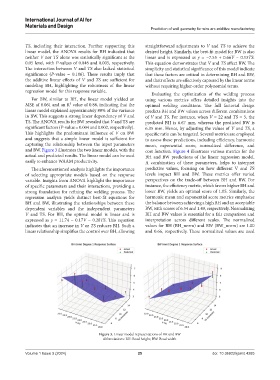
            and BW. Figure 3 illustrates the two linear models, with the   cost function. Figure 4 illustrates various metrics for the
            actual and predicted results. The linear model can be used   BH and BW predictions of the linear regression model.
            easily to enhance WAAM productivity.               A combination of these parameters, helps to interpret
              The aforementioned analysis highlights the importance   predictive values, focusing on how different  V and TS
            of selecting appropriate models based on the response   levels impact BH and BW. These metrics offer varied
            variable. Insights from ANOVA highlight the importance   perspectives on the trade-off between BH and BW. For
            of specific parameters and their interactions, providing a   instance, the efficiency metric, which favors higher BH and
            strong foundation for refining the welding process. The   lower BW, yields an optimal score of 1.05. Similarly, the
            regression analysis yields distinct best-fit equations for   harmonic mean and exponential score metrics emphasize
            BH and BW, illustrating the relationships between these   the balance between achieving a high BH and an acceptable
            dependent variables and the independent parameters   BW, with scores of 6.54 and 1.49, respectively. Normalizing
            V and TS. For BH, the optimal model is linear and is   BH and BW values is essential for a fair comparison and
            expressed as y = 11.74 − 0.17V − 0.28TS. This equation   interpretation across different scales. The normalized
            indicates that an increase in V or TS reduces BH. Such a   values for BH (BH_norm) and BW (BW_norm) are 1.00
            linear relationship simplifies the control over BH, allowing   and 0.66, respectively. These normalized values are used


                                           Figure 3. Linear model representations of BH and BW
                                             Abbreviations: BH: Bead height; BW: Bead width.


            Volume 1 Issue 3 (2024)                         25                             doi: 10.36922/ijamd.4285

