


Page 34 - IJAMD-1-3
P. 34
International Journal of AI for
            Materials and Design
                                                                 Prediction of wall geometry for wire arc additive manufacturing


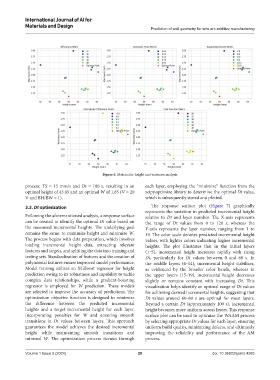
                                             Figure 6. Metrics for height and waviness analysis

            process:  TS = 15  mm/s and  Dt = 100 s, resulting in an   each layer, employing the “minimize” function from the
            optimal height of 43.85 and an optimal W of 1.85 (V = 20   scipy.optimize library to determine the optimal Dt value,
            V and BH/BW = 1).                                  which is subsequently stored and plotted.
            3.3. Dt optimization                                 The  response surface  plot  (Figure  7)  graphically
                                                               represents the variation in predicted incremental height
            Following the aforementioned analysis, a response surface   relative to  Dt and layer number. The X-axis represents
            can be created to identify the optimal Dt value based on   the range of  Dt values from 0 to 120 s, whereas the
            the measured incremental heights. The underlying goal   Y-axis represents the layer number, ranging from 1 to
            remains the same: to maximize height and minimize W.   19. The color scale denotes predicted incremental height
            The process begins with data preparation, which involves   values, with lighter colors indicating higher incremental
            loading  incremental  height  data,  extracting  relevant   heights. The plot illustrates that in the initial layers
            features and targets, and splitting the data into training and   (1‒5), incremental height increases rapidly with rising
            testing sets. Standardization of features and the creation of   Dt, particularly for  Dt values between 0 and 60 s. In
            polynomial features ensure improved model performance.   the middle layers (6‒14), incremental height stabilizes,
            Model training utilizes an XGBoost regressor for height   as evidenced by the broader color bands, whereas in
            prediction owing to its robustness and capability to tackle   the upper layers (15‒19), incremental height decreases
            complex  data  relationships,  while  a  gradient-boosting   slightly or remains constant with increasing  Dt. This
            regressor is employed for  W prediction. These models   visualization helps identify an optimal range of Dt values
            are selected to improve the accuracy of predictions. The   for achieving desired incremental heights, suggesting that
            optimization objective function is designed to minimize   Dt values around 60‒80 s are optimal for most layers.
            the difference between the predicted incremental   Beyond a certain Dt (approximately 100 s), incremental
            heights and a target incremental height for each layer,   height becomes more uniform across layers. This response
            incorporating penalties for  W and ensuring smooth   surface plot can be used to optimize the WAAM process
            transitions in  Dt values between layers. This approach   by selecting appropriate Dt values for each layer, ensuring
            guarantees the model achieves the desired incremental   uniform build quality, minimizing defects, and ultimately
            height while maintaining smooth transitions and    improving  the  reliability  and  performance  of  the  AM
            minimal  W. The optimization process iterates through   process.


            Volume 1 Issue 3 (2024)                         28                             doi: 10.36922/ijamd.4285

