


Page 43 - IJB-2-2
P. 43
Behnam  Taidi, Guillaume  Lebernede, Lothar Koch,  et al.

            shake-flask  culture in  a photo-incubator (25°C)  with
            an atmosphere enriched in CO 2  (up to 2.0%  by vol-
            ume). The light at the surface of the shaken cultures
                                 −2 −1
            was 20 µmol photons m s . The rotational speed of
            the orbital shaking platform was 100 rpm with a rotatio-
            nal diameter of 50 cm. S. bayanus was grown in YPD
            medium under the same conditions. The  flasks were
            only filled to 1/5 of their total volume and stoppered
            with foam bungs (11901935 - X100; Fisher Scientific).

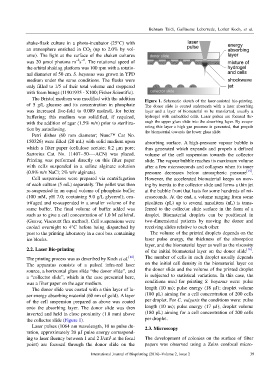
               The Bristol medium was modified with the addition   Figure 1.  Schematic sketch of the laser-assisted bio-printing.
            of  5 g/L glucose and its  concentration  in phosphate   The donor slide is  coated underneath with a laser absorbing
            was increased five-fold to  0.009 moles/L for better   layer and a layer of biomaterial to be transferred, usually  a
            buffering; this  medium was solidified, if required,   hydrogel with  embedded  cells.  Laser pulses are focused thr-
            with the addition of agar (1.5% w/v) prior to steriliza-  ough the upper glass slide into the absorbing layer. By evapo-
            tion by autoclaving.                               rating this layer a high gas pressure is generated, that propels
                                                               the biomaterial towards the lower glass slide.
               Petri dishes (60 mm diameter; Nunc™  Cat No.
            150326) were filled (20 mL) with solid medium upon   absorbing surface. A high-pressure vapour bubble  is
            which  a filter paper (cellulose acetate; 0.2  µm pore;   thus generated which expands and propels a defined
            Sartorius Cat. No.  11407--50----ACN) was placed.   volume of the cell suspension  towards the  collector
            Printing  was performed  directly  on this filter paper   slide. The vapour bubble reaches its maximum volume
            with cells suspended in a saline alginate solution   after a few microseconds and collapses when its inner
            (0.9% w/v NaCl; 2% w/v alginate).                  pressure decreases  below atmospheric pressure [15] .
               Cell suspensions were  prepared  via  centrifugation   However, the accelerated biomaterial keeps on mov-
            of each culture (5 mL) separately. The pellet was then   ing by inertia to the collector slide and forms a thin jet
            re-suspended in an equal volume of phosphate buffer   at the bubble front that lasts for some hundreds of mi-
            (100 mM, pH 7.0; containing 9.0 g/L glycerol); cen-  croseconds. At the end, a volume ranging from some
            trifuged and re-suspended in a smaller volume of the   picoliters (pL) up to several nanoliters (nL) is trans-
            same buffer.  The final  volume of  buffer added was   ferred to  the collector slide surface in the form of a
            such as to give a cell concentration of 1.0 M cells/mL   droplet. Biomaterial droplets can be  positioned in
            (Guava; Viacount flex method). Cell suspensions were   two-dimensional  patterns by  moving the  donor and
            cooled overnight  to  4°C before being dispatched  by   receiving slides relative to each other.
            post to the printing laboratory in a cool box containing   The volume of the printed droplets depends on the
            ice blocks.                                        laser pulse energy, the thickness of the absorption
                                                               layer, and the biomaterial layer as well as the viscosity
            2.2. Laser Bio-printing                            of the initial biomaterial layer on the donor slide [16] .

            The printing process was as described by Koch et al. [14] .   The number of cells in each droplet usually depends
            The apparatus consists  of  a  pulsed  infra-red laser   on the initial cell density in the biomaterial layer on
            source, a horizontal glass slide “the donor slide”, and   the donor slide and the volume of the printed droplet
            a “collector slide”, which in the case presented here,   is subjected to statistical  variations. In this case, the
            was a filter paper on the agar medium.             conditions used  for printing  S. bayanus  were: pulse
               The donor slide was coated with a thin layer of la-  length (10 ns); pulse energy (18 µJ); droplet volume
            ser energy absorbing material (60 nm of gold). A layer   (180 pL) aiming for a cell concentration of 200 cells
            of the cell suspension prepared as above was coated   per droplet. For C. vulgaris the conditions were: pulse
            onto the absorbing layer.  The donor slide  was then   length (10 ns); pulse energy (17 µJ); droplet volume
            inverted and held in close proximity (1.0 mm) above   (180 pL) aiming for a cell concentration of 200 cells
            the collector slide (Figure 1).                    per droplet.
               Laser pulses (1064 nm wavelength, 10 ns pulse du-  2.3. Microscopy
            ration, approximately 20 µJ pulse energy correspond-
            ing to laser fluency between 1 and 2 J/cm² at the focal   The development of colonies on the surface of filter
            point) are  focused through the donor slide on the     papers was  observed  using a Zeiss confocal micro-
                                        International Journal of Bioprinting (2016)–Volume 2, Issue 2      39

