


Page 42 - IJB-2-2
P. 42
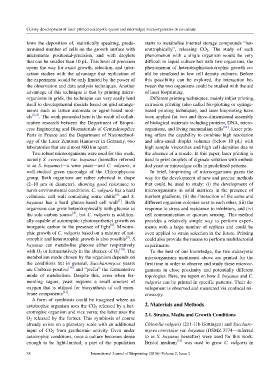
Colony development of laser printed eukaryotic (yeast and microalga) microorganisms in co-culture

            lows the  deposition of, statistically speaking,  prede-  starts to metabolise internal storage compounds “het-
            termined number of cells on the growth surface with   erotrophically”,  releasing CO 2. The study of such
            micrometre positional-precision, and with  droplets   phenomenon  with a single organism would be very
            that can be smaller than 10 pL. This level of precision   difficult in liquid culture but with two organisms, the
            opens the way for exact growth, selection, and inter-  phenomenon  of heterotrophic/autotrophic growth co-
            action studies with the advantage that replication  of   uld be simulated in low cell density cultures. Before
            the experiment would be only limited by the power of   this  possibility can  be explored, the  interaction be-
            the observation and data analysis techniques. Another   tween the two organisms could be studied with the aid
            advantage of this technique is that by printing micro-  of laser bioprinting.
            organisms in grids, the technique can very easily lend   Different printing techniques, mainly inkjet printing,
            itself to developmental models based on grid arrange-  extrusion printing (also called bio-plotting or syringe-
            ments such  as lattice automata or  agent-based mod-  based printing technique), and laser bioprinting have
            els [2–5] . The work presented here is the result of collab-  been applied for two and three-dimensional assembly
            orative research  between the Department of Biopro-  of biological materials including proteins, DNA, micro-
            cess Engineering and Biomaterials of Centralesupélec   organisms, and living mammalian cells [12] . Laser prin-
            Paris in France and the Department of Nanotechnol-  ting  offers the capability to combine high resolution
            ogy of the Laser Zentrum Hannover in Germany, two   and ultra-small  droplet volumes (below 10 pL)  with
            laboratories that are almost 800 km apart.         high sample viscosities and high cell densities due to
               Two robust microorganisms were used for this work,   the absence of a nozzle. In this paper, laser printing is
            namely S. cerevisiae var. bayanus (hereafter referred   used to print droplets of alginate solution with embed-
            to as S. bayanus)—a wine yeast—and C. vulgaris, a   ded yeast or microalgae cells in predefined patterns.
            well-studied green  microalga of the  Chlorophyceae   In brief, bioprinting of  microorganisms  paves the
            group.  Both  organisms are rather spherical in shape   way for the development of new and precise methods
            (2–10  µm in  diameter), showing good resistance to   that could  be used to study: (i) the  development of
            harsh environmental conditions. C. vulgaris has a hard   microorganisms in solid  matrices in the presence of
                                                  [6]
            cellulosic  cell wall containing some chitin   and  S.   nutrient gradients, (ii) the interaction of the same and
                                                   [7]
            bayanus  has a  hard glucan-based  cell wall . Both   different organism-colonies next to each other, (iii) the
            organisms can grow heterotrophically with glucose as   response to stress and resistance to inhibitors, and (iv)
                                [8]
            the sole carbon source , but C. vulgaris is addition-  cell communication or quorum sensing. This method
            ally capable of autotrophic (photosynthetic) growth on   provides a relatively simple way to perform experi-
                                                [9]
            inorganic carbon in the presence of light . Mixotro-  ments with  a large number of replicas  and could  be
            phic growth of C. vulgaris based on a mixture of aut-  even applied to strain selection in the future. Printing
                                                       [9]
            otrophic and heterotrophic growth is also possible . S.   could also provide the means to perform multifactorial
            bayanus  can  metabolise glucose  either respiratively   experiments.
                                                    [10]
            with O 2 or fermentatively in the absence of O 2  . The   To the  best of our knowledge, the two eukaryotic
            metabolism mode chosen by the organism depends on   microorganisms  mentioned  above are printed  for the
            the conditions  but in general,  Saccharomyces  yeasts   first time in order to observe and study these microor-
            are Crabtree-positive [10]  and “prefer” the fermentative   ganisms in close proximity and potentially different
            mode of  metabolism. Despite this, even when fer-  topologies. Here, we report on how S. bayanus and C.
            menting sugars, yeast requires  a small amount  of   vulgaris can be printed in specific patterns. Their de-
            oxygen that is utilised for biosynthesis of cell mem-  velopment is observed and measured via confocal mi-
            brane components [11] .                            croscopy.
               A form of symbiosis could be imagined where an
            autotrophic organism uses the CO 2 released by a het-  2. Materials and Methods
            erotrophic organism and vice versa; the latter uses the   2.1. Strains, Media and Growth Conditions
            O 2  released  by the former. This symbiosis of course
            already exists on a planetary scale with an additional   Chlorella vulgaris (211-11b Göttingen) and Saccharo-
            input of  CO 2  from geothermic activity. Even under   myces cerevisiae var. bayanus (DSMZ 3774—referred
            autotrophic conditions, once a culture becomes dense   to as  S. bayanus  hereafter) were  used for this work.
            enough to  be light-limited, a part of  the population   Bristol medium [13]   was used  to grow  C. vulgaris  in

            38                          International Journal of Bioprinting (2016)–Volume 2, Issue 2

