


Page 76 - IJB-2-2
P. 76
Producing hip implants of titanium alloys by additive manufacturing


                                    (A)                                                                              (B)


                                    (C)                                                                           (D)
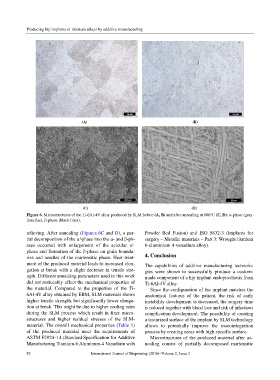
            Figure 6. Microstructures of the Ti-6Al-4V alloy produced by SLM before (A, B) and after annealing at 800°С (C, D): α-phase (gray
            lamellae), β-phase (black lines).

            relieving. After annealing (Figures 6C and D), a par-  Powder  Bed  Fusion) and ISO 5832-3 (Implants for
            tial decomposition of the α′-phase into the α- and β-ph-  surgery – Metallic materials – Part 3: Wrought titanium
            ases  occurred  with  enlargement  of  the  acicular  α′-   6-aluminium 4-vanadium alloy).
            phase and formation of the β-phase on grain bounda-
            ries and needles of the martensitic phase. Heat treat-  4. Conclusion
            ment of the produced material leads to increased elon-  The capabilities of additive  manufacturing technolo-
            gation at break with a slight decrease in tensile stre-  gies were shown to successfully produce a custom-
            ngth. Different annealing parameters used in this work   made component of a hip implant endoprosthesis from
            did not noticeably affect the mechanical properties of   Ti-6Al-4V alloy.
            the material.  Compared to the properties of the Ti-   Since the configuration of the implant matches the
            6Al-4V alloy obtained by EBM, SLM materials shows   anatomical features of the patient,  the  risk  of early
            higher tensile strength, but significantly lower elonga-  instability development is decreased, the surgery time
            tion at break. This might be due to higher cooling rates   is reduced together with blood loss and risk of infectious
            during the SLM process which result in finer micro-  complication development. The possibility of creating
            structures and higher residual stresses  of the SLM-   a texturized surface of the implant by SLM technology
            material. The overall mechanical properties (Table 1)   allows to potentially improve the  osseointegration
            of the  produced material  meet the requirements of   process by creating areas with high specific surface.
            ASTM F2924–14 (Standard Specification for Additive   Microstructures of the produced material after an-
            Manufacturing Titanium-6 Aluminum-4 Vanadium with   nealing consist of partially decomposed  martensitic

            82                          International Journal of Bioprinting (2016)–Volume 2, Issue 2

