


Page 74 - IJB-2-2
P. 74
Producing hip implants of titanium alloys by additive manufacturing


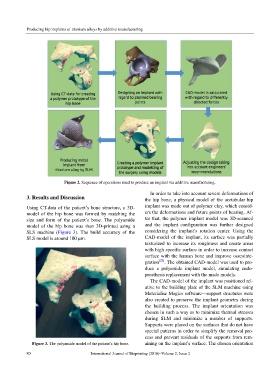
                            Figure 2. Sequence of operations used to produce an implant via additive manufacturing.

                                                                 In order to take into account severe deformations of
            3. Results and Discussion                          the hip bone, a physical model of the acetabular hip
            Using CT-data of  the patient’s bone structure, a 3D-   implant was made out of polymer clay, which consid-
            model  of the  hip bone was formed by  matching  the   ers the deformations and future points of bearing. Af-
            size and form of  the  patient’s bone. The polyamide   ter that, the polymer implant model was 3D-scanned
            model  of the hip  bone was then  3D-printed using a   and the implant configuration was further designed
            SLS  machine (Figure 3). The  build accuracy of  the   considering the  implant’s rotation center. Using  the
            SLS model is around 100 µm.                        CAD-model of the implant, its surface  was partially
                                                               texturized  to  increase its roughness  and create  areas
                                                               with high specific surface in order to increase contact
                                                               surface with the human bone and improve osseointe-
                                                               gration [28] . The obtained CAD-model was used to pro-
                                                               duce a  polyamide implant  model, simulating endo-
                                                               prosthesis replacement with the made models.
                                                                 The CAD-model of the implant was positioned rel-
                                                               ative to the building plate of the SLM machine using
                                                               Materialise Magics software—support structures were
                                                               also created to preserve the implant geometry during
                                                               the building  process. The implant orientation was
                                                               chosen in such a way as to minimize thermal stresses
                                                               during SLM and  minimize a number  of supports.
                                                               Supports were placed on the surfaces that do not have
                                                               special patterns in order to simplify the removal pro-
                                                               cess and prevent residuals of the supports from rem-

               Figure 3. The polyamide model of the patient’s hip bone.   aining on the implant’s surface. The chosen orientation
            80                          International Journal of Bioprinting (2016)–Volume 2, Issue 2

