


Page 75 - IJB-2-2
P. 75
Anatoliy Popovich, Vadim Sufiiarov, Igor Polozov,  et al.

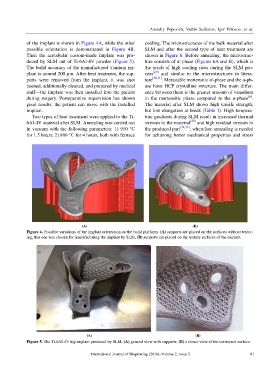
            of the implant is shown in Figure 4A, while the other   cooling. The microstructures of the bulk material after
            possible orientation  is  demonstrated in  Figure 4B.   SLM and after the second type of heat treatment are
            Then  the acetabular custom-made implant was  pro-  shown in Figure 6. Before annealing, the microstruc-
            duced by SLM out of Ti-6Al-4V powder (Figure 5).   ture consists of α′-phase (Figures 6A and B), which is
            The build accuracy of the manufactured titanium im-  the result of high cooling rates during the SLM pro-
            plant is around 200 µm. After heat treatment, the sup-  cess [29]   and similar to the  microstructures in litera-
            ports were removed from  the  implant,  it was shot   ture [30,31] . Metastable martensitic α′-phase and the α-ph-
            peened, additionally cleaned, and prepared by medical   ase have  HCP  crystalline structure. The  main differ-
            staff—the implant was then installed into the patient   ence between them is the greater amount of vanadium
                                                                                                           [6]
            during surgery. Postoperative supervision has shown   in  the  martensitic  phase  compared  to  the  α-phase .
            good results; the patient can move with the installed   The material  after SLM shows high tensile strength,
            implant.                                           but low elongation at break (Table 1). High tempera-
               Two types of heat treatment were applied to the Ti-   ture gradients during SLM result in increased thermal
            6Al-4V material after SLM. Annealing was carried out   stresses in the material [29]  and high residual stresses in
            in vacuum with the following parameters: 1) 950 °С   the produced part [32,33] ; wherefore annealing is needed
            for 1.5 hours; 2) 800 °С for 4 hours; both with furnace   for achieving better mechanical properties and stress


                                    (A)                                                                              (B)
            Figure 4. Possible variations of the implant orientation on the build platform: (A) supports are placed on the surfaces without textur-
            ing, this one was chosen for manufacturing the implant by SLM, (B) supports are placed on the texture surfaces of the implant.


                                         (A)                                                                           (B)
            Figure 5. The Ti-6Al-4V hip implant produced by SLM: (A) general view with supports; (B) a closer view of the texturized surface.

                                        International Journal of Bioprinting (2016)–Volume 2, Issue 2      81

