


Page 73 - IJB-2-2
P. 73
Anatoliy Popovich, Vadim Sufiiarov, Igor Polozov,  et al.

            sion surgery 10–15 years after the first implantation.   Selective Laser Sintering (SLS) from polyamide  po-
            Aseptic instability  and  paraprosthetic osteolysis are   wder using a 3D Systems Sinterstation HiQ+HS ma-
            considered to be the main reasons for the loosening of   chine.  After making a polyamide  model of  the pa-
            implants [14] .                                    tient’s  bone, the  design  of  the  implant configuration
               The most frequent method of an unsteady implant   was carried out using CAD-software. Owing to severe
            replacement is the  installation of acetabular  compo-  deformations of  the hip  bone, the physical model of
            nents with press-fit  fixation  in the presence of  un-  the implant was made out of polymer clay, taking into
            harmed  support bones [15−17] . Three-flank acetabular   account  anatomical features of the  patient.  The im-
            systems are modeled based on computed tomography   plant was 3D-scanned  using a Faro Platinum  Arm
            (CT) data of the patient, designing a 3D-model of pa-  scanner to obtain a CAD-file of the implant. The con-
            tient’s hip bones considering bone defects, and allow-  figuration of the implant was further improved using
            ing angles of dimensional orientation of the acetabular   CAD-software; in particular, a partial texturing of the
            component.                                         implant surface has been done.
               Titanium alloys—Ti-6Al-4V in particular—are wi-   Ti-6Al-4V Grade 5 powder was used as the initial
            dely used in different industries. One of the applica-  material for  manufacturing the  metal implant,  pro-
            tion of Ti-6Al-4V alloys is the manufacturing of med-  duced  by plasma atomization.  The particles  have a
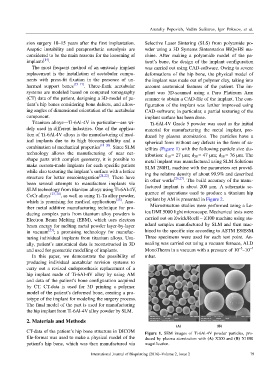
            ical  implants due to its high  biocompatibility  and  a   spherical form without any defects in the form of sa-
            combination of mechanical properties [18−20] . Since SLM   tellites (Figure 1) with the following particle size dis-
            technology allows the manufacturing of near  net-   tribution: d 10 = 27 µm; d 50 = 47 µm; d 90 = 76 µm. The
            shape parts with complex geometry, it is possible to   metal implant was manufactured using SLM Solutions
            make custom-made implants for each specific patient   SLM 280HL machine with the parameters set provid-
            while also texturing the implant’s surface with a lattice   ing the relative density of about 99.9% and described
            structure for better osseointegration [21,22] . There have     [26,27]
            been several attempts to  manufacture implants via   in other works  . The build accuracy of the manu-
            SLM technology from titanium alloys using Ti-6Al-4V,   factured  implant is  about  200  µm.  A schematic se-
            CoCr alloys [23, 24] , as well as using Ti-Ta alloy powder,   quence of  operations  used to produce a titanium  hip
            which is promising for medical applications [25] . Ano-  implant by AM is presented in Figure 2.
            ther metal additive manufacturing technique for pro-  Microstructure studies were performed using a Le-
            ducing complex parts from titanium alloy powders is   ica DMI 5000 light microscope. Mechanical tests were
            Electron Beam Melting  (EBM),  which  uses electron   carried out on Zwick/Roell – Z100 machine using sta-
            beam energy for melting metal powder layer-by-layer   ndard samples manufactured by SLM and then mac-
            in vacuum [23]   ; a promising technology  for  manufac-  hined to the specific size according to ASTM E8/E8M.
            turing individual implants from titanium alloys. Usu-  Three  specimens were  used for each  test  point.  An-
            ally, patient’s anatomical data is reconstructed in 3D   nealing was carried out using a vacuum furnace, ALD
                                                                                                           −4
                                                                                                       −3
            and used for geometric modelling of implants.      MonoTherm in a vacuum with a pressure of 10 –10
               In this paper, we demonstrate the  possibility  of   mbar.
            producing individual acetabular revision  systems to
            carry out a revised endoprosthesis replacement of a
            hip implant  made of Ti-6Al-4V alloy by using AM
            and data of the patient’s bone configuration acquired
            by CT. CT-data  is used for 3D printing a  polymer
            model of the patient’s deformed bone, creating a pro-
            totype of the implant for modeling the surgery process.
            The final model of the part is used for manufacturing
            the hip implant from Ti-6Al-4V alloy powder by SLM.
            2. Materials and Methods
                                                                            (A)                          (B)
            CT-data of the patient’s hip bone structure in DICOM   Figure 1.  SEM images of Ti-6Al-4V powder particles, pro-
            file-format was used to make a physical model of the   duced by plasma atomization with  (A)  X200 and  (B)  X1000
            patient’s hip bone, which was then manufactured via   magnification.

                                        International Journal of Bioprinting (2016)–Volume 2, Issue 2      79

