


Page 198 - IJB-10-5
P. 198
International Journal of Bioprinting                                 Structural design of D-surface scaffolds


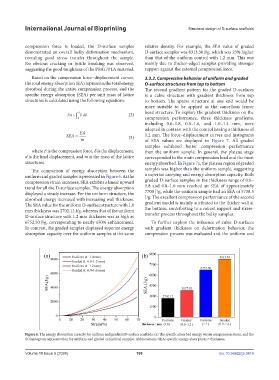
            compression force  is  loaded,  the  D-surface  samples   relative  density. For  example, the  SEA  value  of  graded
            demonstrated  an  overall  bulky  deformation  mechanism,   D-surface samples was 8313.30 J/g, which was 23% higher
            revealing good stress transfer throughout the sample.   than that of the uniform control with 1.2 mm. This was
            No  obvious  cracking  or  brittle  breaking  was  observed,   mainly due to thicker-edged samples providing stronger
            suggesting the good toughness of the PBAT/PLA material.   support against the external compression force.
               Based on the compression force–displacement curves,   3.2.2. Compressive behavior of uniform and graded
            the total energy absorption (EA) represents the total energy   D-surface structures from top to bottom
            absorbed during the entire compression process, and the   The  second  gradient  pattern  for  the  graded  D-surfaces
            specific energy absorption (SEA) per unit mass of lattice   is a cubic structure with gradient thickness from top
            structures is calculated using the following equations:   to bottom. The sparse structure at one end would be
                                                               more suitable to be applied as the cancellous femur
                              EA =   d Fdδ              (2)    head structure. To explore the gradient thickness on the
                                 ∫  0                          compression performance, three thickness gradients,
                                                               including 0.6–1.8, 0.8–1.6, and 1.0–1.4 mm, were
                                                               adopted in contrast with the control having a thickness of
                                   EA
                             SEA =  m                   (3)    1.2 mm. The force–displacement curves and histograms
                                                               of SEA values are displayed in  Figure 7. All graded
                                                               samples exhibited better compression performance
               where F is the compression force, δ is the displacement,   than the uniform sample. In general, the plateau stage
            d is the final displacement, and m is the mass of the lattice   corresponded to the main compression load and the most
            structures.                                        energy absorbed. In Figure 7a, the plateau region of graded
               The comparison of energy absorption between the   samples was higher than the uniform sample, suggesting
            uniform and graded samples is presented in Figure 6. As the   a superior carrying and energy absorption capacity. Both
            compression strain increases, SEA exhibits a linear upward   graded D-surface samples in the thickness range of 0.6–
            trend for all the D-surface samples. The energy absorption   1.8 and 0.8–1.6 mm reached an SEA of approximately
            displayed a steady increase. For the uniform structure, the   7700 J/g, while the uniform sample had an SEA of 5738.3
            absorbed energy increased with increasing wall thickness.   J/g. The excellent compression performance of the second
            The SEA value for the uniform D-surface structure with 1.0   gradient model is mainly attributed to the thicker wall at
            mm thickness was 2702.12 J/g, whereas that of the uniform   the bottom, contributing to a robust support and stress-
            D-surface structure with 1.2 mm thickness was as high as   transfer process throughout the bulky samples.
            6752.50 J/g, corresponding to nearly 150% enhancement.   To further explore the influence of cubic D-surfaces
            In contrast, the graded samples displayed superior energy   with gradient thickness on deformation behavior, the
            absorption capacity over the uniform samples at the same   compression process was evaluated and the uniform and


            Figure 6. The energy absorption capacity for uniform and gradient D-surface scaffolds. (a) The specific absorbed energy versus compression strain, and the
            (b) histogram representation for uniform and graded cylindrical samples. Abbreviations: SEA: specific energy absorption; t: thickness.


            Volume 10 Issue 5 (2024)                       190                                doi: 10.36922/ijb.3416

