


Page 59 - IJB-6-1
P. 59
Huyan, et al.
           hydrogel  extract  constituted  the  control.  10  μl   cell density of 1 × 10  cells/ml. The combination
                                                                                    6
           CCK-8 solutions were added to each well of the      of cells  and hydrogel  was used to print  the  3D
           plate and incubated at 37°C for 4 h. Absorbance     structure, which was then cultured  in a CO
                                                                                                              2
           at a wavelength of 450 nm was measured using        incubator at 5% CO , 37°C , and evaluated using
                                                                                        [18]
                                                                                 2
           a microplate reader. All results are presented as   live and dead staining of the cells on days 1, 4,
           optical density (OD) values minus the absorbance    and  7. Cell  growth was observed  using a Laser
           of blank wells.  The  distribution  of cells  was   Confocal  Microscope  (Nikon  A1). Live  cells
           observed using fluorescence microscopy.             appeared green and dead cells red.
           2.1.3 3D bioprinter                                 2.1.5 Bioprinting of 3D printed bilayer skin graft

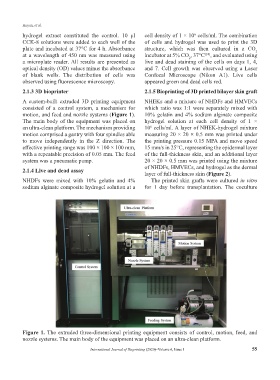
           A custom-built  extruded 3D  printing equipment     NHEKs and a mixture of NHDFs and HMVECs
           consisted  of a  control  system,  a  mechanism  for   which ratio was 1:1 were separately mixed with
           motion, and feed and nozzle systems (Figure 1).     10% gelatin  and 4% sodium  alginate  composite
           The main body of the equipment was placed on        hydrogel solution at each cell  density of 1 ×
           an ultra-clean platform. The mechanism providing    10  cells/ml. A layer of NHEK-hydrogel mixture
                                                                 6
           motion comprised a gantry with four spindles able   measuring 20 × 20 × 0.5 mm was printed under
           to move independently  in the  Z direction.  The    the printing pressure 0.15 MPA and move speed
           effective printing range was 100 × 100 × 100 mm,    15 mm/s in 25°C, representing the epidermal layer
           with a repeatable precision of 0.05 mm. The feed    of the full-thickness skin, and an additional layer
           system was a pneumatic pump.                        20 × 20 × 0.5 mm was printed using the mixture
                                                               of NHDFs, HMVECs, and hydrogel as the dermal
           2.1.4 Live and dead assay
                                                               layer of full-thickness skin (Figure 2).
           NHDFs  were  mixed  with  10%  gelatin  and  4%       The printed skin grafts were cultured in vitro
           sodium alginate composite hydrogel solution at a    for 1  day before transplantation.  The  coculture


           Figure 1. The extruded three-dimensional printing equipment consists of control, motion, feed, and
           nozzle systems. The main body of the equipment was placed on an ultra-clean platform.

                                       International Journal of Bioprinting (2020)–Volume 6, Issue 1        55

