


Page 61 - IJB-6-2
P. 61
Zolfagharian, et al.
           maximum  endpoint  deflection  in  the  subsequent   this reason and vastly voltage driven model of the
           cycle is observed by means of peak envelop lines,   polyelectrolyte  actuator,  the  deflections  of  both
           as shown in Figure 8. Further experiments were      actuators at the completion of cycle are quite alike.
           conducted  to  compare  the  bending  behavior  of   However, TO bioprinted actuator always outpaced
           the  two-material  topology-optimized  actuator     the non-optimized one at all the tests during the
           with  entirely  one  material  actuator.  The  results   voltage “ON” interval.
           proved  the  performance  improvement  of  the        The bending of the 3D-printed polyelectrolyte
           two-material  TO  soft  actuator  compared  to  the   actuators  could  be  determined  based  on  the
           entirely  bioprinted  one,  as  shown  in  Figures  9   Donnan  equilibrium  theory ,  osmotic  pressure
                                                                                          [43]
           and 10.  Looking  at  the  details  of  Figure  10,  it   difference  Δπ  between  both  sides  of  the
           can be seen that the two-material TO bioprinted     polyelectrolyte  actuator  according  to  a  formula
           actuator exhibited larger bending compared to the   developed  by  Shiga [16,44] ,  in  which  the  osmotic
           bioprinted material 2 lattice during the actuation   pressure difference Δπ was equal to the maximum
           process. Accordingly, when the input signal was                                        6DEY
           turned off the bending relaxation of the topology-  tensile stress σ as follows: ∆=π  σ  =  L 2    (15)
           optimized  actuator  took  placed  at  0.022  rad/s
           which is greater than that shown by the material      where,  E  is  the  elastic  modulus,  Y  the  bending
           2 bioprinted soft actuator at 0.013 rad/s with the   deflection, D the thickness, and L length of the actuator
           same volume fraction but lighter structure. Due to   prior  to  bending.  Therefore,  when  the  dimensions
                                                               (D, L, E) are constant, the larger osmotic pressure
           A                                                   difference Δπ results in greater bending deflection.
                                                                 There  are  several  electroactuation  and
                                                               electrochemical  factors  contributing  to  the


                                                                         A


                                                                         B
           B


                                                                         C


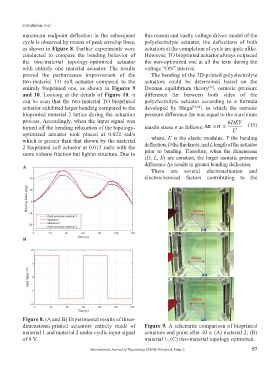
           Figure 8. (A and B) Experimental results of three-
           dimensional-printed  actuators  entirely  made  of   Figure 9. A schematic comparison of bioprinted
           material 1 and material 2 under cyclic input signal   actuators end point after 40 s; (A) material 2; (B)
           of 8 V.                                             material 1; (C) two-material topology optimized.

                                       International Journal of Bioprinting (2020)–Volume 6, Issue 2        57

