


Page 59 - IJB-6-2
P. 59
Zolfagharian, et al.
A
B
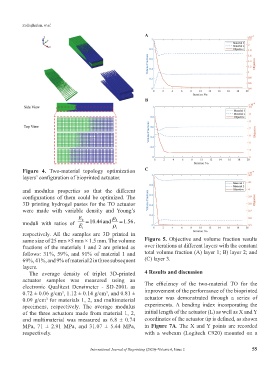
Figure 4. Two-material topology optimization C
layers’ configuration of bioprinted actuator.
and modulus properties so that the different
configurations of them could be optimized. The
3D printing hydrogel pastes for the TO actuator
were made with variable density and Young’s
moduli with ratios of E 2 = 10 44. and 2 = 156. ,
E
1 1
respectively. All the samples are 3D printed in
same size of 25 mm ×5 mm × 1.5 mm. The volume Figure 5. Objective and volume fraction results
fractions of the materials 1 and 2 are printed as over iterations at different layers with the constant
follows: 31%, 59%, and 91% of material 1 and total volume fraction (A) layer 1; B) layer 2; and
69%, 41%, and 9% of material 2 in three subsequent (C) layer 3.
layers.
The average density of triplet 3D-printed 4 Results and discussion
actuator samples was measured using an The efficiency of the two-material TO for the
electronic Qualitest Densimeter - SD-200L as
0.72 ± 0.06 g/cm , 1.12 ± 0.14 g/cm , and 0.81 ± improvement of the performance of the bioprinted
3
3
0.09 g/cm for materials 1, 2, and multimaterial actuator was demonstrated through a series of
3
specimens, respectively. The average modulus experiments. A bending index incorporating the
of the three actuators made from material 1, 2, initial length of the actuator (L) as well as X and Y
and multimaterial was measured as 6.8 ± 0.74 coordinates of the actuator tip is defined, as shown
MPa, 71 ± 2.91 MPa, and 31.07 ± 5.44 MPa, in Figure 7A. The X and Y points are recorded
respectively. with a webcam (Logitech C920) mounted on a
International Journal of Bioprinting (2020)–Volume 6, Issue 2 55

