


Page 59 - IJB-6-3
P. 59
Pakhomova, et al.
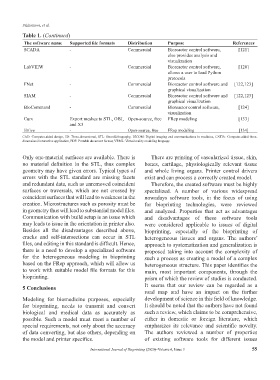
           Table 1. (Continued)
           The software name   Supported file formats  Distribution     Purpose                     References
           SCADA               -                       Commercial       Bioreactor control software,   [121]
                                                                        also provides analysis and
                                                                        visualization
           LabVIEW             -                       Commercial       Bioreactor control software,   [120]
                                                                        allows a user to load Python
                                                                        protocols
           FNet                -                       Commercial       Bioreactor control software and   [122,123]
                                                                        graphical visualization
           SIAM                -                       Commercial       Bioreactor control software and   [122,123]
                                                                        graphical visualization
           BioCommand          -                       Commercial       Bioreactor control software,   [124]
                                                                        visualization
           Curv                Export meshes to STL, OBJ,  Open-source, free  FRep modeling           [133]
                               and X3
           libfive             -                       Open-source, free  FRep modeling                [134]
           CAD: Computer-aided design, 3D: Three-dimensional, STL: StereoLithography, DICOM: Digital imaging and communications in medicine, CATIA: Computer-aided three-
           dimensional interactive application, PDF: Portable document format, VRML: Virtual reality modeling language


           Only one-material surfaces are available. There is    There are printing of vascularized tissue, skin,
           no  material  definition  in  the  STL,  thus  complex   bones, cartilage, physiologically  relevant  tissue
           geometry may have given errors. Typical types of    and  whole  living  organs.  Printer  control  drivers
           errors with the STL standard are missing facets     exist and can process a correctly created model.
           and redundant data, such as unremoved coincident      Therefore, the created software must be highly
           surfaces or traversals, which are not crossed by    specialized.  A number  of various  widespread
           coincident surfaces that will lead to weakness in the   nowadays software tools, in the focus of using
           creation. Microstructures such as porosity must be   for bioprinting technologies, were reviewed
           in geometry thus will lead to substantial model files.   and analyzed. Properties that act as advantages
           Communication with build setup is an issue which    and disadvantages  of these  software tools
           may leads to issue in the orientation in printer also.   were considered applicable  to issues of digital
           Besides all the disadvantages described above,      bioprinting,  especially  of the  bioprinting  of
           cracks  and  self-intersections  can  occur  in  STL   heterogeneous  tissues  and  organs.  The  authors’
           files, and editing in this standard is difficult. Hence,   approach to systematization and generalization is
           there is a need to develop a specialized software   proposed  taking  into  account  the  complexity  of
           for the heterogeneous modeling in bioprinting       such a process as creating a model of a complex
           based on the FRep approach, which will allow us     heterogeneous structure. This paper identifies the
           to work with suitable model file formats for this   main,  most important  components, through the
           bioprinting.                                        prism of which the review of studies is conducted.

           5 Conclusions                                       It  seems that our review  can  be  regarded  as a
                                                               road map and have an impact  on the further
           Modeling  for biomedicine purposes, especially      development of science in this field of knowledge.
           for  bioprinting,  needs  to  transmit  and  convert   It should be noted that the authors have not found
           biological  and medical  data as accurately  as     such a review, which claims to be comprehensive,
           possible.  Such a  model  must  meet  a  number  of   either  in  domestic  or foreign  literature,  which
           special requirements, not only about the accuracy   emphasizes  its  relevance  and  scientific  novelty.
           of data converting, but also others, depending on   The authors reviewed a number of properties
           the model and printer specifics.                    of existing software tools for different issues

                                       International Journal of Bioprinting (2020)–Volume 6, Issue 3        55

