


Page 41 - IJB-7-1
P. 41
Attarilar, et al.
           Table 2. (Continued)

           AM method      Characteristics                   Results                                 References
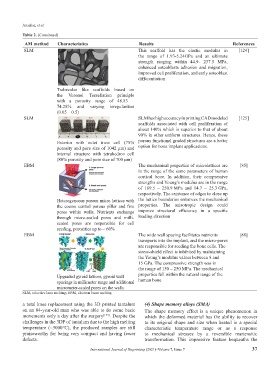
           SLM                                              This scaffold has the elastic  modulus in   [124]
                                                            the  range  of  1.93-5.24GPa  and  an  ultimate
                                                            strength  ranging  within  44.9-  237.5  MPa,
                                                            enhanced  osteoblasts  adhesion  and  migration,
                                                            improved cell proliferation, and early osteoblast
                                                            differentiation

                         Trabecular  like  scaffolds  based  on
                         the  Voronoi  Tessellation  principle
                         with  a  porosity  range  of  48.83  –
                         74.28%   and   varying  irregularities
                         (0.05 – 0.5)
           SLM                                              SLM has high accuracy in printing CAD modeled   [125]
                                                            scaffolds associated  with  cell  proliferation  of
                                                            about 140% which is superior to that of about
                                                            90% in other uniform structures. Hence, these
                         Exterior  with  octet  truss  cell  (75%   porous functional graded structures are a better
                         porosity and pore size of 1042 μm) and   option for bone implant applications.
                         internal  structure  with  tetrahedron  cell
                         (80% porosity and pore size of 700 μm)
           EBM                                              The mechanical properties of microlattices are   [85]
                                                            in the range of the same parameters of human
                                                            cortical  bone.  In  addition,  their  compressive
                                                            strengths and Young’s modulus are in the range
                                                            of  169.5  –  250.9 MPa  and  14.7  –  25.3 GPa,
                                                            respectively. The existence of edges to close up
                         Heterogeneous porous micro lattices with   the lattice boundaries enhances the mechanical
                         the  coarse  central  porous  pillar  and  fine   properties.  The  anisotropic  design  could
                         pores  within  walls.  Nutrients  exchange   improve  structural  efficiency  in  a  specific
                         through  micro-scaled  pores  and  milli-  loading direction
                         scaled  pores  are  responsible  for  cell
                         seeding, porosities up to ∼ 60%
           EBM                                              The wide wall spacing facilitates nutrients   [88]
                                                            transports into the implant, and the micro-pores
                                                            are responsible for seeding the bone cells. The
                                                            stress-shield effect is inhibited by maintaining
                                                            the Young’s modulus values between 8 and
                                                            15 GPa. The compressive strength was in
                                                            the range of 150 – 250 MPa. The mechanical
                         Upgraded gyroid lattices, gyroid wall   properties fall within the natural range of the
                         spacings in millimeter range and additional   human bone
                         micrometer-scaled pores on the walls
           SLM, selective laser melting; EBM, electron beam melting.

           a total knee replacement using the 3D printed tantalum   (4) Shape memory alloys (SMA)
           on an 84-year-old man who was able to do some basic   The  shape  memory  effect  is  a  unique  phenomenon  in
           movements only a day after the surgery [133] . Despite the   which the deformed material has the ability to recover
           challenges in the 3DP of tantalum due to the high melting   to its original shape and size when heated in a special
           temperature  (~3000°C),  the  produced  samples  are  still   characteristic  temperature  range or as a response
           praiseworthy for being very compact and having fewer   to  mechanical  stresses  by  a  reversible  martensitic
           defects.                                            transformation.  This  impressive  feature  bequeaths  the

                                       International Journal of Bioprinting (2021)–Volume 7, Issue 7        37

