


Page 112 - IJB-7-2
P. 112
Technique of Thyroid Cartilage Scaffold Support Formation
                        A                           B                         C


                        D                           E                         F


                        G                                         H


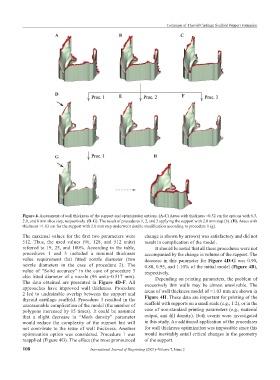
           Figure 4. Assessment of wall thickness of the support and optimization options. (A-C) Areas with thickness <0.52 cm for options with 0.5,
           2.0, and 8 mm slice step, respectively. (D-G). The result of procedures 1, 2, and 3 applying the support with 2.0 mm step (b). (H). Areas with
           thickness <1.03 cm for the support with 2.0 mm step underwent double modification according to procedure 1 (g).

           The maximal values for the first two parameters were   change is shown by arrows) was satisfactory and did not
           512.  Thus, the used values (96, 128, and 512 units)   result in complication of the model.
           referred to 19, 25, and 100%. According to the table,   It should be noted that all these procedures were not
           procedures 1 and 3 included a minimal thickness     accompanied by the change in volume of the support. The
           value  requirement  that  fitted  nozzle  diameter  (two   decrease in this parameter  for  Figure  4D-G was 0.90,
           nozzle diameters in the case of procedure 2).  The   0.80, 0.95, and 1.10% of the initial model (Figure 4B),
           value of “Solid accuracy” in the case of procedure 3   respectively.
           also fitted diameter of a nozzle (96 units–0.517 mm).   Depending on printing parameters, the problem of
           The data obtained are presented in  Figure  4D-F. All   excessively  thin  walls may  be almost  unsolvable.  The
           approaches have improved wall thickness. Procedure   areas of wall thickness model of <1.03 mm are shown in
           2 led to undesirable overlap between the support and
           thyroid cartilage scaffold. Procedure 3 resulted in the   Figure 4H. These data are important for printing of the
           unreasonable complication of the model (the number of   scaffold with supports on a small scale (e.g., 1:2), or in the
           polygons increased by 15 times). It could be assumed   case of non-standard printing parameters (e.g., material
           that a slight decrease in “Mesh density” parameter   output, and fill density). Both events were investigated
           would reduce the complexity of the support but will   in this study. An additional application of the procedures
           not contribute to the issue of wall thickness. Another   for wall thickness optimization was impossible since this
           optimization option was considered. Procedure 1 was   would inevitably entail critical changes in the geometry
           reapplied (Figure 4G). The effect (the most pronounced   of the support.

           108                         International Journal of Bioprinting (2021)–Volume 7, Issue 2

