


Page 51 - IJB-8-1
P. 51
Ng, et al.
                        A


                        B


                        C


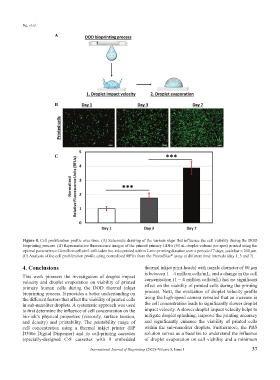
           Figure 8. Cell proliferation profile over time. (A) Schematic drawing of the various steps that influence the cell viability during the DOD
           bioprinting process. (B) Representative fluorescence images of the printed primary HDFs (30 nL droplet volume per spot) printed using the
           optimal parameters of 4 million cells/mL cell-laden bio-inks printed within 2-min printing duration over a period of 7 days; scale bar = 200 µm.
           (C) Analysis of the cell proliferation profile using normalized RFUs from the PrestoBlue  assay at different time intervals (day 1, 3 and 7).
                                                                          ®
           4. Conclusions                                      thermal inkjet print-heads) with nozzle diameter of 80 µm
                                                               is between 1 – 4 million cells/mL, and a change in the cell
           This  work  pioneers  the  investigation  of  droplet  impact
           velocity and droplet evaporation on viability of printed   concentration (1 – 4 million cells/mL) has no significant
           primary  human  cells  during  the  DOD  thermal  inkjet   effect on the viability of printed cells during the printing
           bioprinting process. It provides a better understanding on   process. Next, the evaluation of droplet velocity profile
           the different factors that affect the viability of printed cells   using the high-speed camera revealed that an increase in
           in sub-nanoliter droplets. A systematic approach was used   the cell concentration leads to significantly slower droplet
           to first determine the influence of cell concentration on the   impact velocity. A slower droplet impact velocity helps to
           bio-ink’s  physical  properties  (viscosity,  surface  tension,   mitigate droplet splashing, improve the printing accuracy
           and density) and printability.  The printability range of   and  significantly  enhance  the  viability  of  printed  cells
           cell  concentration  using  a  thermal  inkjet  printer  (HP   within the sub-nanoliter droplets. Furthermore, the PBS
           D300e Digital Dispenser) and its cell-printing cassettes   solution serves as a baseline to understand the influence
           (specially-designed C-8 cassettes with 8 embedded   of droplet evaporation on cell viability and a minimum

                                       International Journal of Bioprinting (2022)–Volume 8, Issue 1        37

