


Page 213 - IJB-9-1
P. 213
International Journal of Bioprinting                                 FeS /PCL scaffold for bone regeneration
                                                                                    2


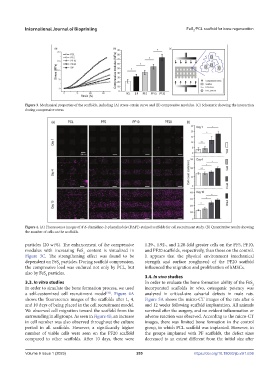
            Figure 3. Mechanical properties of the scaffolds, including (A) stress–strain curve and (B) compressive modulus. (C) Schematic showing the interaction
            during compressive stress.


            Figure 4. (A) Fluorescence images of 4′,6-diamidino-2-phenylindole (DAPI)-stained scaffolds for cell recruitment study. (B) Quantitative results showing
            the number of cells on the scaffolds.

            particles (20 wt%). The enhancement of the compressive   1.29-, 1.92-, and 2.20-fold greater cells on the PF5, PF10,
            modulus with increasing FeS  content is visualized in   and PF20 scaffolds, respectively, than those on the control.
                                     2
            Figure 3C. The strengthening effect was found to be   It appears that the physical environment (mechanical
            dependent on FeS  particles. During scaffold compression,   strength and surface roughness) of the PF20 scaffold
                          2
            the compressive load was endured not only by PCL, but   influenced the migration and proliferation of hMSCs.
            also by FeS  particles.
                     2                                         3.4. In vivo studies
            3.3. In vitro studies                              In order to evaluate the bone formation ability of the FeS
                                                                                                             2
            In order to simulate the bone formation process, we used   incorporated scaffolds  in vivo, osteogenic potency was
            a self-customized cell  recruitment model .  Figure  4A   analyzed in critical-size calvarial defects in male rats.
                                              [32]
            shows the fluorescence images of the scaffolds after 1, 4,   Figure 5A shows the micro-CT images of the rats after 6
            and 10 days of being placed in the cell recruitment model.   and 12 weeks following scaffold implantation. All animals
            We observed cell migration toward the scaffold from the   survived after the surgery, and no evident inflammation or
            surrounding in all groups. As seen in Figure 4B, an increase   adverse reaction was observed. According to the micro-CT
            in cell number was also observed throughout the culture   images, there was limited bone formation in the control
            period in all scaffolds. However, a significantly higher   group, in which PCL scaffold was implanted. However, in
            number  of viable  cells were seen on the PF20  scaffold   the groups implanted with PF scaffolds, the defect sizes
            compared to  other  scaffolds.  After  10  days,  there  were   decreased to an extent different from the initial size after


            Volume 9 Issue 1 (2023)olume 9 Issue 1 (2023)
            V                                              205                      https://doi.org/10.18063/ijb.v9i1.636

