


Page 177 - IJB-9-2
P. 177
International Journal of Bioprinting                          3D Printing Multifunctional Orthopedic Biocoatings


            The fast degradation of PCL in contact with the buffer or   and net charge [85,88] . Thus, the adsorption of VA molecules
            presence of free VA particles on the film surface due to   on the surfaces of nanosized ACP particles is highly
            the poor encapsulation of VA inside the PCL films most   feasible. On contact with water, some of these adsorbed
            likely caused the burst release of VA at the beginning of   VA  molecules  diffused  out  in  the  solution,  thereby
            elution for samples R-1 and R-2. However, the degradation   resulting in a more sustained release in sample R-3. The
            of PCL under physiological buffers has shown to be very   decrease in the rate of release of VA over time is presumed
            slow, and therefore, rapid dissolution of the inadequately   partially due to the reduction in easily soluble amorphous
            encapsulated VA causes the burst release . Moreover,   content of the ACP powder on the particle surface, combined
                                               [81]
            this rapid dissolution of the VA should create pores within   with the conversion of the ACP phase into hydroxyapatite
            the PCL matrix. In the latter time points, the rest of the   by dissolution precipitation as well as the strongly adsorbed
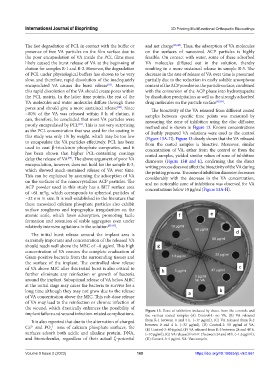
            VA molecules and water molecules diffuse through these   drug molecules on the particle surface [85,89] .
            pores and should give a more sustained release . Since   The bioactivity of the VA released from different coated
                                                   [82]
            ~80%  of the  VA was  released  within 8  h  of elution, it   samples  between  specific  time  points  was  measured  by
            can, therefore, be concluded that most VA particles were   measuring  the  zone of  inhibition  using the  disc  diffusion
            poorly encapsulated by PCL . This is not very surprising   method and is shown in Figure 13. Known concentrations
                                  [83]
            as the PCL concentration that was used for the coating in   of freshly prepared VA solutions were used as the control
            this study was only 1% by weight, which may be too low   (Figure 13A-H). Figure 13 clearly shows that the VA released
            to encapsulate the VA particles effectively. PCL has been   from the coated samples is bioactive. Moreover, similar
            used to coat  β-tricalcium phosphate composites, and it   concentration of VA, either from the control or from the
            has been shown that higher PCL-containing coatings   coated samples, yielded similar values of zone of inhibition
            delay the release of VA . The above argument of poor VA   diameters (Figure  13B  and  E), confirming that the direct
                              [84]
            encapsulation, however, does not hold for the sample R-3,   writing process does not affect the bioactivity of the VA during
            which showed much-sustained release of VA over time.   the printing process. The zone of inhibition diameter decreases
            This can be explained by assuming the adsorption of VA   considerably with the decrease in the VA concentration,
            on the surfaces of the nanocrystalline ACP particles. The   and no noticeable zone of inhibitions was observed for VA
            ACP powder used in this study has a BET surface area   concentrations below 10 µg/ml (Figure 13A-H).
            of ~61 m /g, which corresponds to spherical particles of
                    2
            ~32 nm in size. It is well-established in the literature that
            these nanosized calcium phosphate particles also exhibit
            surface  roughness  and topographic  irregularities on  the
            atomic scale, which favor adsorption, promoting facile
            formation and retention of stable aggregates even under
            relatively intensive agitations in the solution [85-87] .

              The initial burst release around the implant area is
            extremely important and concentration of the released VA
            should reach well above the MBC of ~8 µg/ml. This high
            concentration of VA ensures the complete eradication of
            Gram-positive bacteria from the surrounding tissues and
            the surface of the implant. The controlled slow release
            of VA above MIC after this initial burst is also critical to
            further  eliminate  any  reinfection  or  growth  of  bacteria
            around the implant. Suboptimal release of VA below MBC
            at the initial stage may cause the bacteria to survive for a
            long time although they may not grow due to the release
            of VA concentration above the MIC. This sub-dose release
            of VA may lead to the reinfection or chronic infection of
            the wound, which drastically enhances the possibility of   Figure 13. Zone of inhibition induced by elutes from the controls and
            implant failure and wound infection-related complications.  the  various  coated  samples  (A)  Control-1:  no  VA,  (B)  VA  released

              It is also reported that due to the alternation of charged   from R-1 between 0 and 4  h. (~37 µg/ml), (C) VA released from R-2
            Ca  and PO  ions of calcium phosphate surfaces, the   between 0 and 4  h. (~32  µg/ml),  (D) Control-2:  50  µg/ml  of VA,
                       3−
              2+
                                                               (E) Control-3: 40 µg/ml, (F) VA released from R-3 between 24 and 48 h.
                       4
            surfaces adsorb both acidic and alkaline protein, DNA,   (~10 µg/ml), (G) VA released from R-2 between 24 and 48 h. (~1.6 µg/ml),
            and biomolecules, regardless of their actual  ζ-potential   (H) Control-3: 5 µg/ml. VA: Vancomycin.
            Volume 9 Issue 2 (2023)                        169                      https://doi.org/10.18063/ijb.v9i2.661

