


Page 455 - IJB-9-2
P. 455
International Journal of Bioprinting                    Fabrication of 3D functional hydrogel for wound dressings


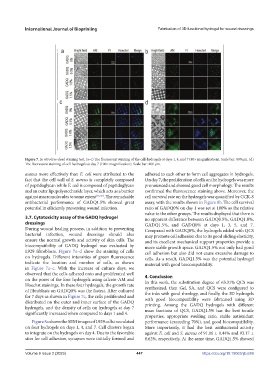
            Figure 7. In vitro live-dead staining test. (a–c) The fluorescent staining of the cell-hydrogels at days 1, 4, and 7 (40× magnification). Scale bar: 800 μm. (d)
            The fluorescent staining of cell-hydrogels at day 7 (100× magnification). Scale bar: 400 μm.
            aureus more effectively than E. coli were attributed to the   adhered to each other to form cell aggregates in hydrogels.
            fact that the cell wall of S. aureus is completely composed   On day 7, the proliferation of cells on the hydrogels was more
            of peptidoglycan while E. coli is composed of peptidoglycan   pronounced and showed good cell morphology. The results
            and an outer lipopolysaccharide layer, which acts as a barrier   confirmed the fluorescence staining above. Moreover, the
            against macromolecules to some extent [55,56] . The remarkable   cell survival rate on the hydrogels was quantified by CCK-8
            antibacterial performance of GADQ1.5% showed great   assay, with the results shown in Figure 8b. The cell survival
            potential in efficiently preventing wound infection.  ratio of GADQ0% on day 1 was set at 100% as the relative
                                                               value to the other groups. The results displayed that there is
            3.7. Cytotoxicity assay of the GADQ hydrogel       no apparent difference between GADQ0.5%, GADQ1.0%,
            dressings                                          GADQ1.5%,  and GADQ0% at  days 1,  3, 5,  and 7.
            During wound healing process, in addition to preventing   Compared with GADQ0%, the hydrogels added with QCS
            bacterial infection, wound dressings should also   may promote cell adhesion due to its good sliding elasticity,
            ensure the normal growth and activity of skin cells. The   and its excellent mechanical support properties provide a
            biocompatibility of GADQ hydrogel was evaluated by   more stable growth space. GADQ1.5% not only had good
            L929 fibroblasts.  Figure 7a–d show the staining of cells   cell adhesion but also did not cause excessive damage to
            on hydrogels. Different intensities of green fluorescence   cells. As a result, GADQ1.5% was the potential hydrogel
            indicate the location and number of cells, as shown   material with good biocompatibility.
            in  Figure 7a–c. With the increase of culture days, we
            observed that the cells adhered onto and proliferated well   4. Conclusion
            on the pores of the four hydrogels using calcein-AM and   In this work, the substitution degree of 63.31% QCS was
            Hoechst stainings. In these four hydrogels, the growth rate   synthesized, then Gel, SA, and QCS were configured to
            of fibroblasts on GADQ0% was the fastest. After cultured   the inks with good rheology, and finally, the 3D hydrogels
            for 7 days as shown in Figure 7c, the cells proliferated and   with good biocompatibility were fabricated using 3D
            distributed on the outer and inner surface of the GADQ   printing. Among the GADQ hydrogels with different
            hydrogels, and the density of cells on hydrogels at day 7   mass fractions of QCS, GADQ1.5% has the best tensile
            significantly increased when compared to days 1 and 4.
                                                               properties, appropriate swelling ratio, stable antioxidant
               Figure 8a shows the SEM images of L929 cells inoculated   performance (exceeding 70%), and good biocompatibility.
            on four hydrogels on days 1, 4, and 7. Cell clusters began   More importantly, it had the best antibacterial activity
            to integrate on the hydrogels on day 4. Due to the favorable   against E. coli and S. aureus of 91.06 ± 0.44% and 93.17 ±
            sites for cell adhesion, synapses were initially formed and   0.62%, respectively. At the same time, GADQ1.5% showed


            Volume 9 Issue 2 (2023)                        447                          https://doi.org/10.18063/ijb.689

