


Page 450 - IJB-9-2
P. 450
International Journal of Bioprinting Fabrication of 3D functional hydrogel for wound dressings
sterilized Luria–Bertani broth (LB) medium (10 mL), with 60%, 75%, 95%, and 100% ethanol solutions for 30
respectively. The sterilized hydrogel (200 mg) was added min, respectively. The samples were sputter-coated with
to the culture medium injected with bacteria described gold, and the growth of cells on the scaffolds were observed
above and incubated in a shaker with 100 rpm at 37°C for using scanning electron microscope.
24 h. The group without hydrogel was set as the positive
control, and the group inoculated with no bacteria was set 2.11.4. Cytotoxicity test for the GADQ hydrogels
as the negative control. Then, 20-μL bacterial suspension The relative viability of cells on GADQ hydrogels was
was evenly coated on the Nutrient Agar (NA) plates detected by CCK-8 test. The cell-hydrogels cultured for 1,
after diluting to a particular gradient, and cultured in an 3, 5, and 7 days were immersed in 300 μL of CCK-8 reagent
incubator at 37°C for 24 h. Finally, the colony forming in each well, and incubated at 37°C for 2.5 h. After uniform
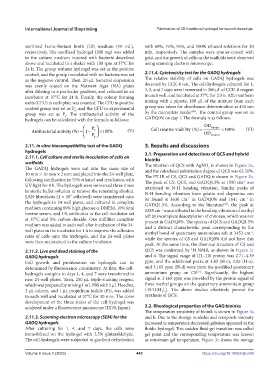
units (CFU) in each plate was counted. The CFU in positive mixing with a pipette, 100 μL of the mixture from each
control group was set as P , and the CFU in experimental group was taken for absorbance determination at 450 nm
0
[49]
group was set as P . The antibacterial activity of the by the microplate reader . The control group was set as
s
hydrogels can be calculated with the formula as follows: GADQ0% on day 1. The formula is as follows:
P Cellrelativeviability (%) = OD Sample ×100 % (VI)
Antibacterial activity (%) = 1− P S 0 × 100% (V) OD Control
2.11. In vitro biocompatibility test of the GADQ 3. Results and discussions
hydrogels 3.1. Preparation and detections of QCS and hybrid
2.11.1. Cell culture and sterile inoculation of cells on bioinks
scaffolds The titration of QCS with AgNO is shown in Figure 2a,
The GADQ hydrogels were cut into the same size of and the calculated substitution degree of QCS was 63.31%.
3
10 mm × 10 mm × 2 mm and placed into the 24-well plate, The FT-IR of CS, QCS and GADQ is shown in Figure 2b.
following sterilization in 75% ethanol and irradiation with The peak of CS, QCS, and GADQ1.5% at 1590 cm was
-1
UV light for 8 h. The hydrogels were immersed three times attributed to N-H bending vibration. Similar peaks of
in sterile buffer solution to remove the remaining alcohol. N-H bending vibration from gelatin and dopamine can
L929 fibroblasts (1 × 10 cells/well) were transferred onto be found at 1630 cm in GADQ0% and 1641 cm in
5
-1
-1
the hydrogels in 24-well plates, and cultured in complete GADQ1.5%. According to the literature , the peak at
[50]
medium containing 89% high glucose α-DMEM, 10% fetal 1385 cm was attributed to the bending vibration of methyl
-1
bovine serum, and 1% antibiotics in the cell incubator set left by incomplete deacetylation of chitosan, which was not
at 37°C and 5% carbon dioxide. One milliliter complete present in GADQ0%. The spectra of QCS and GADQ1.5%
medium was added to each well after incubation of the 24- had a distinct characteristic peak corresponding to the
well plates in the incubator for 1 h to improve the adhesion methyl bond of quaternary ammonium salt at 1453 cm ,
-1
ratio of cells onto the hydrogels, and the 24-well plates while the spectra of CS and GADQ0% did not have this
were then maintained in the culture incubator.
peak. At the same time, the chemical structure of CS and
1
2.11.2. Live and dead staining of the QCS was confirmed by H NMR, as shown in Figure 2c
GADQ hydrogels and d. The signal range of H1–H6 proton was 2.71–4.39
Cell growth and proliferation on hydrogels can be ppm, and the additional peaks at 1.83 (H-c), 2.06 (H-a),
determined by fluorescence colorimetry. At first, the cell- and 3.165 ppm (H-d) were from the modified quaternary
[51]
hydrogels complex to days 1, 4, and 7 were transferred to ammonium group on CS . Significantly, the highest
new 24-well plates. Then, 250 μL triple-staining reagent, signal at 3.165 ppm was provided by the proton signal of
which was prepared by mixing 1 mL PBS with 5 μL Hoechst, three methyl groups on the quaternary ammonium group
+
2 μL calcein, and 1 μL propidium iodide (PI), was added (-N (CH ) ). The above studies effectively proved the
3 3
to each well and incubated at 37°C for 30 min. The color synthesis of QCS.
development of the three stains of the cell-hydrogel was
analyzed under a fluorescence microscope (IX70, Japan). 3.2. Rheological properties of the GAQ bioinks
The temperature sensitivity of bioink is shown in Figure 3a
2.11.3. Scanning electron microscopy (SEM) for the and b. Due to the storage modulus and composite viscosity
GADQ hydrogels increased as temperature decreased, gelation appeared in the
After culturing for 1, 4, and 7 days, the cells were fluidic hydrogel. This sudden fluid-gel transition was called
immobilized on the hydrogel with 2.5% glutaraldehyde. gel point and the corresponding temperature was known
The cell-hydrogels were subjected to gradient dehydration as minimum gel temperature. Figure 3c shows the storage
Volume 9 Issue 2 (2023) 442 https://doi.org/10.18063/ijb.689

