


Page 215 - IJB-9-3
P. 215
International Journal of Bioprinting                         Dual ions mixed GelMA for hair follicle regeneration


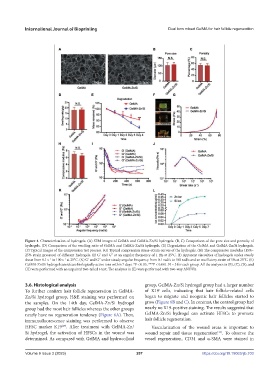
            Figure 4. Characterization of hydrogels. (A) SEM images of GelMA and GelMA-Zn/Si hydrogels. (B, C) Comparison of the pore size and porosity of
            hydrogels. (D) Comparison of the swelling ratio of GelMA and GelMA-Zn/Si hydrogels. (E) Degradation of the GelMA and GelMA-Zn/Si hydrogels.
            (F) Typical images of the compression test process. (G) Typical compression stress–strain curves of the hydrogels. (H) The compressive modulus (15%–
            25% strain pressure) of different hydrogels. (I) G′ and G″ at an angular frequency of 1 Hz at 25°C. (J) Apparent viscosities of hydrogels under steady
                            −1
                      −1
            shear from 0.1 s  to 100 s  at 25°C. (K) G′ and G″ under steady angular frequency from 0.1 rad/s to 100 rad/s and an oscillatory strain of 5% at 25°C. (L)
            GelMA-Zn/Si hydrogel can release biologically active ions within 7 days. *P < 0.05, ***P < 0.001. N = 3 for each group. All the analyses in (B), (C), (D), and
            (H) were performed with an unpaired two-tailed t-test. The analyses in (E) were performed with two-way ANOVA.

            3.6. Histological analysis                         group, GelMA-Zn/Si hydrogel group had a larger number
            To further confirm hair follicle regeneration in GelMA-  of K19 cells, indicating that hair follicle-related cells
                                                                     +
            Zn/Si hydrogel group, H&E staining was performed on   began to migrate and neogenic hair follicles started to
            the samples. On the 14th day, GelMA-Zn/Si hydrogel   grow (Figure 6B and C). In contrast, the control group had
            group had the most hair follicles whereas the other groups   nearly no K19-positive staining. The results suggested that
            nearly have no regeneration tendency (Figure 6A). Then,   GelMA-Zn/Si hydrogel can activate HFSCs to promote
            immunofluorescence staining was performed to observe   hair follicle regeneration.
            HFSC marker K19 . After treatment with GelMA-Zn/      Vascularization of the wound areas is important to
                           [29]
            Si hydrogel, the activation of HFSCs in the wound was   wound repair and tissue regeneration . To observe the
                                                                                              [30]
            determined. As compared with GelMA and hydrocolloid   vessel regeneration, CD31 and α-SMA were stained in

            Volume 9 Issue 3 (2023)                        207                          https://doi.org/10.18063/ijb.703

