


Page 425 - IJB-9-4
P. 425
International Journal of Bioprinting                                  3D bioprinting of artificial blood vessel


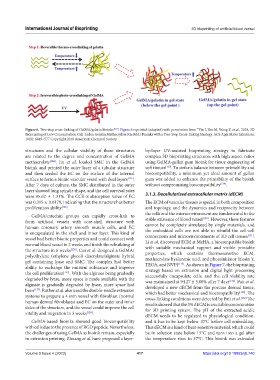
            Figure 6. Two-step cross-linking of GelMA/gelatin bioinks [122] . Figure 6 reprinted (adapted) with permission from “Yin J, Yan M, Wang Y, et al., 2018, 3D
            Bioprinting of Low Concentration Cell-Laden Gelatin Methacrylate (GelMA) Bioinks with a Two-Step Cross-linking Strategy. ACS Appl Mater Interfaces,
            10(8): 6849–57.” Copyright 2018 American Chemical Society.

            structures and the cellular viability of these structures   by-layer UV-assisted bioprinting strategy to fabricate
            are related to the degree and concentration of GelMA   complex 3D bioprinting structures with high aspect ratios
            methacrylate [124] . Jin  et al. loaded SMC in the GelMA   using GelMA-gellan gum bioink for tissue engineering of
            bioink and printed the outer layer of a tubular structure   soft tissues [129] . To strike a balance between printability and
            and then seeded the EC on the surface of the internal   biocompatibility, a minimum yet ideal amount of gellan
            surface to form a bionic vascular vessel with dual layers [125] .   gum was added to enhance the printability of the bioink
            After 7 days of culture, the SMC distributed in the outer   without compromising biocompatibility [129] .
            layer showed long spindle shape, and the cell survival rates
            were 95.62  ±  1.31%. The CCK-8 absorption value of EC   3.1.3. Decellularized extracellular matrix (dECM)
            was 0.315 ±  0.0179, indicating that the structurehas better   The ECM of vascular tissues is special in both composition

            proliferation ability [125] .                      and topology, and the dynamics and reciprocity between
              GelMA/catechin groups can rapidly cross-link to   the cells and the microenvironment are fundamental to the
            form artificial vessels with core-shell structure with   stable existence of blood vessel [130] . However, these features
            human  coronary  artery  smooth  muscle  cells,  and  EC   cannot be completely simulated by single materials, and
            is encapsulated in the shell and inner layer. This kind of   the embedded cells are not able to rebuild the cell-cell
                                                                                                             .
                                                               connections and microenvironments of 3D cell tissues
                                                                                                          [131]
            vessel had better bionic properties and could connect with   Li et al. discovered ECM at MeHA, a biocompatible bioink
            normal blood vessel in 2 weeks and finish the rebuilding of   with suitable mechanical support and visible printable
            the structure in 6 weeks [126] . Cui et al. designed a GelMA/
            polyethylene (ethylene glycol) diacrylate/alginate hybrid   properties, which contains thermosensitive ECM,
            gel containing lyase and SMC. The complex had better   methacrylate hyaluronic acid, and photoinitiator (Eosin Y,
                                                                               . As shown in Figure 7, the bioprinting
                                                               TEOA, and NVP)
                                                                             [132]
            ability to exchange the nutrient substance  and improve   strategy based on extrusion and digital light processing
            the cell proliferation [127] . With the alginate being gradually   successfully encapsulate cells, and the cell viability rate
            degraded by lyase, more space is made available with the   was maintained at 94.27 ± 3.00% after 7 days [132] . Pati et al.
            alginate is gradually degraded by lyase, more space had   developed a new dECM from the porcine dermal tissue,
            been [127] . Ruther et al. also used the double-needle extrusion   which had better mechanical and biocompatibility [133] . The
            systems to prepare a 4 mm vessel with fibroblast (normal   cross-linking conditions were detected by Pati et al. [132]  The
            human dermal fibroblasts) and EC on the outer and inner   results showed that the 3% dECM is a suitable concentration
            sides of the structure, and the vessel could improve the cell   for 3D printing system. The pH of the extracted acidic
            vitality and migration in 3 weeks [128] .
                                                               dECM  needs  to  be  regulated  to  physiological  condition,
              GelMA-based bioinks  showed good biocompatibility   and it has to be kept below 10°C before cell embedding.
            with cells due to the presence of RGD peptide. Nevertheless,   This dECM is a kind of heat-sensitive material, which could
            the challenges of using GelMA as bioink remain, especially   be in solution state below 15°C and turn into a gel after
            in extrusion printing. Zhuang et al. have proposed a layer-  the temperature rises to 37°C. This bioink was extruded


            Volume 9 Issue 4 (2023)                        417                         https://doi.org/10.18063/ijb.740

