


Page 430 - IJB-9-4
P. 430
International Journal of Bioprinting                                  3D bioprinting of artificial blood vessel


                         A


                         B


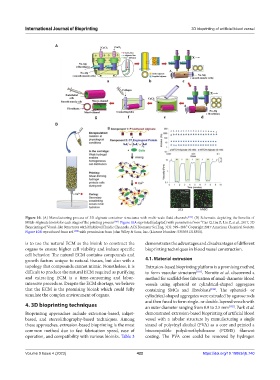
            Figure 10. (A) Manufacturing process of 3D alginate container structures with multi-scale fluid channels [174] . (B) Schematic depicting the benefits of
            Mitch-Alginate bioink for each stage of the printing process [178] . Figure 10A reprinted (adapted) with permission from “Gao Q, Liu Z, Lin Z, et al., 2017, 3D
            Bioprinting of Vessel-like Structures with Multilevel Fluidic Channels. ACS Biomater Sci Eng, 3(3): 399–408.” Copyright 2017 American Chemical Society.
            Figure 10B reproduced from ref. [178]  with permission from John Wiley & Sons, Inc. (License Number: 5355931318350).

            is to use the natural ECM as the bioink to construct the   demonstrates the advantages and disadvantages of different
            organs to ensure higher cell viability and induce specific   bioprinting techniques in blood vessel construction.
            cell behavior. The natural ECM contains compounds and
            growth factors unique to natural tissues, but also with a   4.1. Material extrusion
            topology that compounds cannot mimic. Nonetheless, it is   Extrusion-based bioprinting platform is a promising method
            difficult to produce the natural ECM required as purifying   to form vascular structures [181] . Norotte et al. discovered a
            and  extracting  ECM  is  a  time-consuming  and  labor-  method for scaffold-free fabrication of small-diameter blood
            intensive procedure. Despite the ECM shortage, we believe   vessels using spheroid or cylindrical-shaped aggregates
            that the ECM is the promising bioink which could fully   containing SMCs and fibroblasts [182] . The spheroid-  or
            simulate the complex environment of organs.        cylindrical-shaped aggregates were extruded by agarose rods
                                                               and then fused to form single- or double-layered vessels with
            4. 3D bioprinting techniques                       an outer diameter ranging from 0.9 to 2.5 mm [182] . Park et al.
            Bioprinting approaches include extrusion-based, inkjet-  demonstrated extrusion-based bioprinting of artificial blood
            based,  and stereolithography-based techniques.  Among   vessel with a tubular structure by manufacturing a single
            these approaches, extrusion-based bioprinting is the most   strand of polyvinyl alcohol (PVA) as a core and printed a
            common method due to fast fabrication speed, ease of   biocompatible polydimethylsiloxane (PDMS) filament
            operation, and compatibility with various bioinks. Table 3   coating. The PVA core could be removed by hydrogen


            Volume 9 Issue 4 (2023)                        422                         https://doi.org/10.18063/ijb.740

