


Page 432 - IJB-9-4
P. 432
International Journal of Bioprinting                                  3D bioprinting of artificial blood vessel


                                                               thousands of droplets in seconds through printing in a
                                                                                  . The inkjet bioprinting methods
                               Medium level                    are characterized by microdropletization as well as
                                                               non-contact manner
                                                                                [185]
                          Cost        Low  High                high-throughput, non-contact, and drop-on-demand
                                                                       .  The  key  factors  of  material  jetting  include
                                                               process
                                                                     [185]
                                                               biopaper, bioink, printing parameters, and 3D models.
                                                               The biopaper, which is agar or collagen coating on the
                               Low printing speed  Medium printing speed  Simultaneous cross-linking   of the whole 2D layer   avoids the need of X-Y   culture dishes to fix the cells and increase the cell viability,
                                                               is especially important. However, the rigid substrate of the
                                                               biopapers always  influences  the cell functions. Besides,
                                                               the injection process exerts pressure to cells in bioink.
                          System                movement       Therefore, inkjet bioprinting has more restrictions on

                                                               the viscosity of the bioink, which undoubtedly limits
                          Resolution  Low-to-medium  High (30 μm)  High (~1 μm)  the choice of biomaterial for stimulus response. The
                                                               bioink should have better biocompatibility, degradability,
                                                               fluidity, and viscosity properties. The alginate and CaCl
                                                                                                             2
                                                               have been widely used in inkjet bioprinting, and they are
                                                               used in inkjet bioprinting methods to form alginic acid
                                                               nanoparticles in CaCl  solutions and then assemble the
                                                                                 2
                                                                                            .
                                                               particles into tubular structure
                                                                                       [186,187]
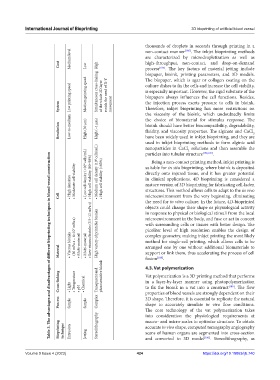
                      Table 3. The advantages and disadvantages of different bioprinting techniques in blood vessel construction
                                                                 Being a non-contact printing method, inkjet printing is
                                                               directly onto injured tissue, and it has greater potential
                               • High densities  • Moderate cell viability  • Low cell density (<10 6  cells/mL) • High cell viability (80–90%) • Medium cell density (10 8  cells/mL)  • High cell viability (>85%)  suitable for in situ bioprinting, where bioink is deposited
                                                               in clinical applications. 4D bioprinting is considered a
                                                               mature version of 3D bioprinting for fabricating cell-laden
                                                               structures. This method allows cells to adapt to the in vivo
                          Cell                                 microenvironment from the very beginning, eliminating
                                                               the need for in vitro culture. In the future, 4D-bioprinted
                                                               objects could change their shape or physiological activity
                                                               in response to physical or biological stimuli from the local
                                                               microenvironment in the body, and fuse or act in concert

                                                               picoliter level of high resolution enables the design of
                               •   Viscous bioinks    (30 mPa·s – 6×10 7  mPa·s)  • Multi‑material  • Multi‑material • Low viscous bioinks (3.5–12 mPa·s)  High variety of printable bioinks  with surrounding cells or tissues with better design. The
                                                               complex geometry, making inkjet printing the most likely
                                                               method for single-cell printing, which allows cells to be
                                                               arranged one by one without additional biomaterials to
                          Material                             support or link them, thus accelerating the process of cell
                                                               fusion
                                                                      .
                                                                    [188]
                          Cross‑linking  • Light  • Temperature  • pH  • Chemical  Transparent and   photosensitive bioink  4.3. Vat polymerization  [189] . The flow
                                                               Vat polymerization is a 3D printing method that performs
                                                               in a layer-by-layer manner using photopolymerization
                                                               to fix the bioink in a vat into a construct
                                                               3D shape. Therefore, it is essential to replicate the natural
                          Process  Simple  Simple  Complex     properties of blood vessels are strongly dependent on their
                                                               shape to accurately simulate  in vivo flow conditions.
                                                               The  core  technology  of  the  vat  polymerization  takes
                                                               into consideration the physiological requirements at
                          Bioprinting   technique  Extrusion  Jetting  Stereolithography  macro- and micro-scales to optimize structure. To obtain
                                                               accurate in vivo shape, computed tomography angiography
                                                               scans of human organs are segmented into cross-section
                                                               and converted to 3D model
                                                                                          . Stereolithography, as
                                                                                        [190]
            Volume 9 Issue 4 (2023)                        424                         https://doi.org/10.18063/ijb.740

