


Page 429 - IJB-9-4
P. 429
International Journal of Bioprinting                                  3D bioprinting of artificial blood vessel


                         A


                         B


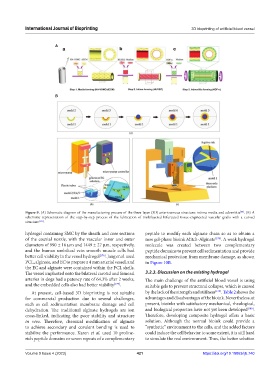
            Figure 9. (A) Schematic diagram of the manufacturing process of the three-layer (3D) arteriovenous structure: intima media and adventitia . (B) A
                                                                                                       [66]
            schematic representation of the step-by-step process of the fabrication of multilayered bifurcated tissue-engineered vascular grafts with a curved
            structure [165] .
            hydrogel containing SMC by the sheath and core sections   peptide to modify each alginate chain so as to obtain a
            of the coaxial nozzle, with the vascular inner and outer   new gel-phase bioink Mitch-Alginate [178] . A weak hydrogel
            diameters of 990 ± 16 μm and 1449 ± 27 μm, respectively,   molecule was created between two complementary
            and the human umbilical vein smooth muscle cells had   peptide domains to prevent cell sedimentation and provide
            better cell viability in the vessel hydrogel [176] . Jang et al. used   mechanical protection from membrane damage, as shown
            PCL, alginate, and EC to prepare a 4 mm arterial vessel, and   in Figure 10B.
            the EC and alginate were contained within the PCL shells.
            The vessel implanted onto the bilateral carotid and femoral   3.2.3. Discussion on the existing hydrogel
            arteries in dogs had a patency rate of 64.3% after 2 weeks,   The main challenge of the artificial blood vessel is using
            and the embedded cells also had better viability [177] .  suitable gels to prevent structural collapse, which is caused
              At present, cell-based 3D bioprinting is not suitable   by the lack of the strength and stiffness [179] . Table 2 shows the
            for commercial production due to several challenges,   advantages and disadvantages of the bioink. Nevertheless, at
            such as cell sedimentation membrane damage and cell   present, bioinks with satisfactory mechanical, rheological,
            dehydration. The traditional alginate hydrogels are ion   and biological properties have not yet been developed [180] .
            cross-linked, indicating the poor stability and structure   Therefore,  developing  composite hydrogel  offers  a  basic
            in  vivo. Therefore, chemical modification of alginate   solution.  Although  the  normal  bioink  could  provide  a
            to  achieve  secondary and  covalent bonding is  used  to   “synthetic” environment to the cells, and the added factors
            stabilize the performance. Karen  et  al. used 10 proline-  could induce the cell behavior to some extent, it is still hard
            rich peptide domains or seven repeats of a complementary   to simulate the real environment. Thus, the better solution


            Volume 9 Issue 4 (2023)                        421                         https://doi.org/10.18063/ijb.740

