


Page 426 - IJB-9-4
P. 426
International Journal of Bioprinting                                  3D bioprinting of artificial blood vessel


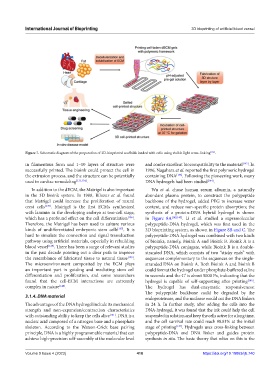
            Figure 7. Schematic diagram of the preparation of 3D-bioprinted scaffolds loaded with cells using visible light cross-linking [134] .

            in filamentous form and 1–10 layers of structure were   and confer excellent biocompatibility to the material [142] . In
            successfully printed. The bioink could protect the cell in   1996, Nagahara et al. reported the first polymeric hydrogel
            the extrusion process, and the structure can be potentially   containing DNA [143] . Following the pioneering work, many
            used in cardiac remodeling [131,134] .             DNA hydrogels had been studied [144] .

              In addition to the dECM, the Matrigel is also important   Wu  et al. chose human serum albumin, a naturally
            in the 3D bioink system. In 1988, Bilozur  et al. found   abundant plasma protein, to construct the polypeptide
            that  Matrigel  could  increase  the  proliferation  of  neural   backbone of the hydrogel, added PEG to increase water
            crest cells [135] . Matrigel is the first ECMs synthesized   content, and reduce non-specific protein absorption; the
            with laminin in the developing embryo at two-cell stage,   synthesis of a protein-DNA hybrid hydrogel is shown
            which has a profound effect on the cell differentiation [136] .   in  Figure  8A [142,145] . Li  et al. studied a supramolecular
            Therefore, the Matrigel has been used to culture various   polypeptide-DNA hydrogel, which was first used in the
            kinds of undifferentiated embryonic stem cells [137] . It is   3D bioprinting system, as shown in Figure 8B and C. The
            hard to simulate the connection and signal transduction   polypeptide-DNA hydrogel was combined with two kinds
            pathway using artificial materials, especially in rebuilding   of bioinks, namely, Bioink A and Bioink B. Bioink A is a
            blood vessel [138] . There has been a surge of relevant studies   polypeptide-DNA conjugate, while Bioink B is a double-
            in the past decade pointing out a clear path to improve   stranded DNA, which consists of two “sticky ends” with
            the resemblance of fabricated tissue to natural tissue [139] .   sequences complementary to the sequences on the single-
            The  microenvironment composited  by the  ECM plays   stranded DNA on Bioink A. Both Bioink A and Bioink B
            an important part in guiding and mediating stem cell   could format the hydrogel under phosphate-buffered saline
            differentiation and proliferation, and some researchers   in seconds and the G’ is about 5000 Pa, indicating that the
            found that the cell-ECM interactions are extremely   hydrogel is capable of self-supporting after printing [146] .
            complex in nature [140] .                          The hydrogel has dual-enzymatic responsiveness:
                                                               The  polypeptide backbone could be degraded by the
            3.1.4. DNA material                                endoproteinase, and the nuclease would cut the DNA linkers
            The advantages of the DNA hydrogel include its mechanical   in 24  h. In further study, after adding the cells into the
            strength  and  non-expansion/contraction  characteristics   DNA-hydrogel, it was found that the ink could help the cell
            with outstanding ability to keep the cells alive [141] . DNA is a   suspended in solution and keep the cells active for a long time,
            nucleic acid composed of a nitrogen base and a phosphate   and the cell survival rate could reach 98.81% at the initial
            skeleton. According to the Watson-Crick base pairing   stage of printing [147] . Hydrogels uses cross-linking between
            principle, DNA is a highly programmable material that can   polypeptide-DNA and DNA linker and guides protein
            achieve high-precision self-assembly at the molecular level   synthesis in situ. The basic theory that relies on this is the


            Volume 9 Issue 4 (2023)                        418                         https://doi.org/10.18063/ijb.740

