


Page 431 - IJB-9-4
P. 431
International Journal of Bioprinting                                  3D bioprinting of artificial blood vessel


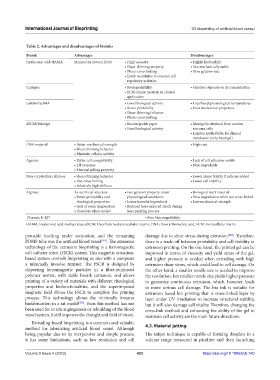
            Table 2. Advantages and disadvantages of bioinks
            Bioink               Advantages                                       Disadvantages
            Hyaluronic acid/HAMA  Mimics the natural ECM  • High viscosity        • Highly hydrophilic
                                                      • Shear‑thinning property   • Not mechanically stable
                                                      • Photo‑cross‑linking       • Slow gelation rate
                                                      •  Easily modifiable to enhance cell
                                                       regulatory activities
            Collagen                                  • Biodegradability          • Gelation depends on its concentration
                                                      •  ECM‑mimic material in clinical
                                                       application
            Gelatin/GelMA                             • Good biological activity  • Liquifies at physiological temperatures
                                                      • Better printability       • Poor mechanical properties
                                                      • Shear‑thinning behavior
                                                      • Photo‑cross‑linking
            dECM/Matrigel                             • Biochargeable paper       •  Matrigel is obtained from murine
                                                      • Good biological activity   sarcoma cells
                                                                                  •  Limited applicability for clinical
                                                                                   translation (only Matrigel)
            DNA material         • Better mechanical strength                     • High cost
                                 • Shear‑thinning behavior
                                 • Maintain cellular activity
            Agarose              • Better cell compatibility                      • Lack of cell adhesion motifs
                                 • pH response                                    • Non‑degradable
                                 • Thermal gelling property
            Nano-crystalline cellulose  • Shear‑thinning behavior                 • Lower shape fidelity if cells are added
                                 • Fast cross‑linking                             • Lower cell viability
                                 • Relatively high stiffness
            Alginate             As sacrificial structure  •  Fast gelation property under   • Biological inert material
                                 •  Better printability and   physiological conditions  • Slow degradation when not cross‑linked
                                  rheological properties  • Lesser harmful byproducts  • Low mechanical strength
                                 • Gels at room temperature  •  Reduced laser‑induced shock during
                                 • Dissolves when cooled  laser printing process
             Pluronic F‑127                                    • Poor biocompatibility
            HAMA: Hyaluronic acid methacrylate, dECM: Decellularized extracellular matrix, DNA: Deoxyribonucleic acid, ECM: Extracellular matrix

            peroxide leaching under sonication, and the remaining   damage due to shear stress during extrusion [184] . Therefore,
            PDMS tube was the artificial blood vessel [183] . The extension   there is a trade-off between printability and cell viability in
            technology of the extrusion bioprinting is a ferromagnetic   extrusion printing. On the one hand, the printed gel can be
            soft catheter robot (FSCR) system. This magnetic actuation-  improved in terms of viscosity and yield stress of the gel,
            based system controls bioprinting in situ with a computer   and higher pressure is needed when extruding with high
            a minimally invasive manner. The FSCR is designed by   extrusion shear stress, which could lead to cell damage. On
            dispersing ferromagnetic particles in a fiber-reinforced   the other hand, a smaller needle size is needed to improve
            polymer matrix, with stable bioink extrusion, and allows   the resolution, but smaller nozzle size yields higher pressure
            printing of a variety of materials with different rheological   to guarantee continuous extrusion, which, however, leads
            properties and biofunctionalities, and the superimposed   to more serious cell damage. The bio ink is suitable for
            magnetic field drives the FSCR to complete the printing   extrusion based bio printing that is cross-linked layer by
            process. This technology allows the minimally invasive   layer under UV irradiation to increase structural stability,
            biofabrication in a rat model [179] . Even this method has not   but it will also damage cell vitality. Therefore, changing the
            been used for in situ angiogenesis or rebuilding of the blood   cross-link method and enhancing the ability of the gel to
            vessel system, it still improves the thought and field of vision.  maintain cell activity are the main future directions.
              Extruding-based bioprinting is a common and valuable
            method for fabricating artificial blood vessel. Although   4.2. Material jetting
            being popular due to its inexpensive and simple process,   The inkjet technique is capable of forming droplets in a
            it has some limitations, such as low resolution and cell   volume  range  measured  in  picoliter  and  then  launching


            Volume 9 Issue 4 (2023)                        423                         https://doi.org/10.18063/ijb.740

