


Page 427 - IJB-9-4
P. 427
International Journal of Bioprinting                                  3D bioprinting of artificial blood vessel


            A                                                B


                                                                C


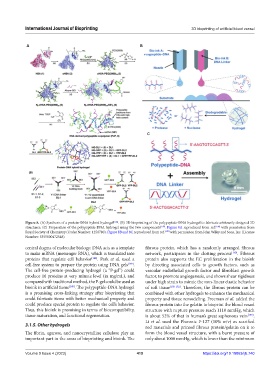
            Figure 8. (A) Synthesis of a protein-DNA hybrid hydrogel [146] . (B) 3D bioprinting of the polypeptide-DNA hydrogel to fabricate arbitrarily designed 3D
            structures. (C) Preparation of the polypeptide-DNA hydrogel using the two components [147] . Figure 8A reproduced from ref. [146]  with permission from
            Royal Society of Chemistry (Order Number: 1250780). Figure 8B and 8C reproduced from ref. [147]  with permission from John Wiley and Sons, Inc. (License
            Number: 5355800472548).

            central dogma of molecular biology: DNA acts as a template   fibrous protein, which has a randomly arranged fibrous
            to make mRNA (messenger RNA), which is translated into   network, participates in the clotting process [150] . Fibrous
            proteins that regulate cell behavior [148] . Park  et  al. used a   protein also supports the EC proliferation in the bioink
            cell-free system to prepare the protein using DNA gels [149] .   by directing associated cells to growth factors, such as
            The cell-free protein-producing hydrogel (a “P-gel”) could   vascular endothelial growth factor and fibroblast growth
            produce 16 proteins at very minute level (in mg/mL), and   factor, to promote angiogenesis, and shows shear rigidness
            compared with traditional method, the P-gel could be used as   under high strain to mimic the non-linear elastic behavior
            bioink in artificial tissue [149] . The polypeptide-DNA hydrogel   of soft tissue [150-152] . Therefore, the fibrous protein can be
            is a promising cross-linking strategy after bioprinting that   combined with other hydrogels to enhance the mechanical
            could fabricate items with better mechanical property and   property and tissue remodeling. Freeman et al. added the
            could produce special protein to regulate the cell’s behavior.   fibrous protein into the gelatin to bioprint the blood vessel
            Thus, this bioink is promising in terms of biocompatibility,   structure with rupture pressure reach 1110 mmHg, which
            tissue maturation, and functional regeneration.    is about 52% of that in human’s great saphenous vein [153] .
                                                               Li  et al. used the Pluronic F-127  (10%  w/v) as scarified
            3.1.5. Other hydrogels                             rod materials and printed fibrous protein/gelatin on it to
            The fibrin, agarose, and nanocrystalline cellulose play an   form the blood vessel structure, with a burst pressure of
            important part in the areas of bioprinting and bioink. The   only about 1000 mmHg, which is lower than the minimum


            Volume 9 Issue 4 (2023)                        419                         https://doi.org/10.18063/ijb.740

