


Page 121 - IJB-9-6
P. 121
International Journal of Bioprinting                                   Exosome-based bioink for bioprinting


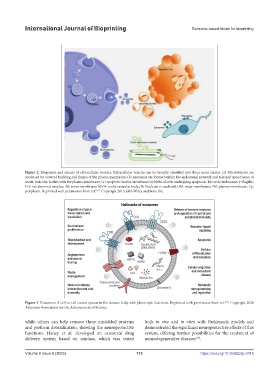
            Figure 2. Biogenesis and release of extracellular vesicles. Extracellular vesicles can be broadly classified into three main classes: (a) Microvesicles are
            produced by outward budding and fission of the plasma membrane; (b) exosomes are formed within the endosomal network and released upon fusion of
            multi-vesicular bodies with the plasma membrane; (c) apoptotic bodies are released as blebs of cells undergoing apoptosis. EE: early endosome; F: flagella;
            ILV: intraluminal vesicles; IM: inner membrane; MVB: multi-vesicular body; N: Nucleus; n: nucleoid; OM: outer membrane; PM: plasma membrane ; Pp:
                                          [17]
            periplasm. Reprinted with permission from ref. . Copyright 2015 John Wiley and Sons, Inc.


            Figure 3. Exosomes: A cell-to-cell transit system in the human body with pleiotropic functions. Reprinted with permission from ref. . Copyright 2020
                                                                                                 [18]
            American Association for the Advancement of Science.

            while others can help remove these misfolded proteins   both  in vivo and  in vitro with Parkinson’s models and
            and perform detoxification, showing the neuroprotective   demonstrated the significant neuroprotective effects of this
            functions. Haney  et al. developed an exosomal drug   system, offering further possibilities for the treatment of
            delivery  system  based  on  oxidase,  which  was  tested   neurodegenerative diseases .
                                                                                     [30]

            Volume 9 Issue 6 (2023)                        113                         https://doi.org/10.36922/ijb.0114

