


Page 191 - IJB-9-6
P. 191
International Journal of Bioprinting                    3D-printed assembly anatomical patella fracture bone plate


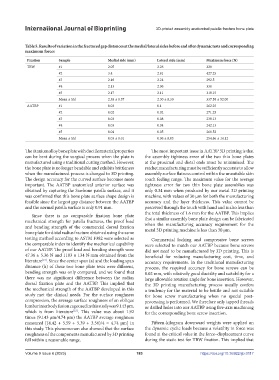
            Table 5. Results of variation in the fractured gap distances at the medial/lateral sides before and after dynamic tests and corresponding
            maximum forces
             Fixation     Sample               Medial side (mm)     Lateral side (mm)    Maximum force (N)
             TBW          #1                   2.05                 2.26                 320
                          #2                   3.4                  2.81                 427.25
                          #3                   2.16                 2.24                 292.5
                          #4                   2.13                 2.06                 330
                          #5                   2.17                 2.11                 318.15
                          Mean ± Std           2.38 ± 0.57          2.30 ± 0.30          337.58 ± 52.00
             AATBP        #1                   0.03                 0.1                  262.25
                          #2                   0.02                 0.02                 271.25
                          #3                   0.03                 0.08                 238.13
                          #4                   0.03                 0.04                 242.13
                          #5                   0.04                 0.05                 260.52
                          Mean ± Std           0.03 ± 0.01          0.06 ± 0.03          254.86 ± 14.12

            The titanium alloy bone plate with ductile material properties   The most important issue in AATBP 3D printing is that
            can be bent during the surgical process when the plate is   the assembly tightness error of the two thin bone plates
            manufactured using a traditional cutting method. However,   at the proximal and distal ends must be minimized. The
            the bone plate is no longer bendable and exhibits brittleness   ratchet manufacturing must be sufficiently accurate to allow
            when the manufactured process is changed to 3D printing.   assembly surface flatness control within the unsuitable skin
            The design accuracy for the curved surface becomes more   touch feeling range. The maximum value for the average
            important. The AATBP anatomical anterior surface was   tightness error for two thin bone plate assemblies was
            obtained by capturing the Sawbone patella surface, and it   only 0.34 mm when produced by our metal 3D printing
            was confirmed that this bone plate surface shape design is   machine, with values of 30 μm for both the manufacturing
            feasible since the largest gap distance between the AATBP   accuracy  and the  layer thickness.  This  value cannot  be
            and the normal patella surface is only 0.91 mm.    perceived through the touch with hand and is also less than
                                                               the total thickness of 1.6 mm for the AATBP. This implies
               Since there is no comparable fixation bone plate
            mechanical strength for patella fractures, the proof load   that a similar assembly bone plate design can be fabricated
                                                               when the  manufacturing accuracy requirement for  the
            and bending strength of the commercial dorsal fixation   metal 3D printing machine is less than 30 μm.
            bone plate for distal radius fracture obtained using the same
            testing method according to ASTM F382 were selected as   Commercial  locking  and  compressive  bone  screws
            the comparable index to identify the mechanical capability   were selected to match our AATBP because bone screws
            of our AATBP. The proof load and bending strength were   did not need to be manufactured by 3D printing. This is
            47.36 ± 5.36 N and 1183 ± 134 N·mm obtained from the   beneficial for reducing manufacturing cost, time, and
                   [21]
            literature . Since the center span (a) and the loading span   accuracy requirements. In the traditional manufacturing
            distance (h) of these two bone plate tests were different,   process, the  required accuracy  for bone screws can be
            bending strength was only compared, and we found that   0.02 mm, with relatively good ductility and suitability for a
            there was no significant difference between the radius   large allowable rotation angle for bone insertion. However,
            dorsal fixation plate and the AATBP. This implied that   the 3D printing manufacturing process usually confers
            the mechanical strength of the AATBP developed in this   a tendency for the material to be brittle and not suitable
            study met the clinical needs. For the surface roughness   for bone screw manufacturing when no special post-
            compression, the average surface roughness of an oblique   processing is performed. We therefore only tapped threads
            lumbar interbody fusion cage used in this study was 9.143 µm,    or drilled holes into our AATBP using five-axis machining
            which is from literature . This value was about 1.92   for the corresponding bone screw insertion.
                                [22]
            times (9.143 µm/4.74 µm) the AATBP average roughness
            measured [(4.42 + 5.59 + 5.39 + 3.56)/4 = 4.74 µm] in   Fifteen-kilogram  downward  weights  were  applied  on
            this study. This phenomenon also showed that the surface   the dynamic cyclic loads because a volatility in force was
            roughness of the components manufactured by 3D printing   found at the critical value in the force–displacement curve
            fell within a reasonable range.                    during the static test for TBW fixation. This implied that

            Volume 9 Issue 6 (2023)                        183                         https://doi.org/10.36922/ijb.0117

