


Page 187 - IJB-9-6
P. 187
International Journal of Bioprinting                    3D-printed assembly anatomical patella fracture bone plate


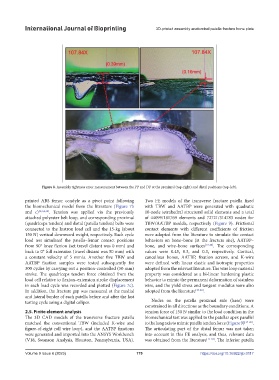
                   Figure 8. Assembly tightness error measurement between the PP and DP at the proximal (top-right) and distal positions (top-left).

            printed ABS femur condyle as a pivot point following   Two  FE  models  of the transverse  fracture  patella fixed
            the  biomechanical  model  from  the  literature  (Figure  7b   with TBW and AATBP were generated with quadratic
            and  c) [2,3,4,16] . Tension was applied via the previously   10-node tetrahedral structural solid elements and a total
            attached polyester belt loop, and corresponding proximal   of 44099/181769 elements and 72721/314783 nodes for
            (quadriceps tendon) and distal (patella tendon) belts were   TBW/AATBP models, respectively (Figure 9). Frictional
            connected to the Instron load cell and the 15-kg (about   contact elements with different coefficients of friction
            150 N) vertical downward weight, respectively. Each cycle   were adopted from the literature to simulate the contact
            load test simulated the patella–femur contact positions   behaviors on bone–bone (at the fracture site), AATBP–
            from 90° knee flexion (set travel distant was 0 mm) and   bone, and wire–bone surfaces [17-20] . The corresponding
            back to 0° full extension (travel distant was 50 mm) with   values were 0.45, 0.3, and 0.3,  respectively. Cortical,
            a constant velocity of 5 mm/s. Another five TBW and   cancellous bones, AATBP, fixation screws, and K-wire
            AATBP fixation samples were tested subsequently for   were  defined  with  linear  elastic  and  isotropic  properties
            300 cycles by carrying out a position-controlled (50 mm)   adopted from the relevant literature. The wire loop material
            stroke. The quadriceps tendon force obtained from the   property was considered as a bi-linear hardening plastic
            load cell relative to flexion–extension stroke displacement   behavior to mimic the permanent deformation of stainless
            in each load cycle was recorded and plotted (Figure 7c).   wire, and the yield stress and tangent modulus were also
            In addition, the fracture gap was measured at the medial   adopted from the literature [17-20] .
            and lateral border of each patella before and after the last
            testing cycle using a digital caliper.                Nodes on the patella proximal side (base) were
                                                               constrained in all directions as the boundary conditions. A
            2.5. Finite element analysis                       tension force of 150 N similar to the load condition in the
            The 3D CAD models of the transverse fracture patella   biomechanical test was applied to the patellar apex parallel
            matched the conventional TBW (included K-wire and   to the long axis to mimic patella tendon force (Figure 9) [17-20] .
            figure-of-eight roll wire loop), and the AATBP fixations   The articulating part of the distal femur was not taken
            were generated and imported into the ANSYS Workbench   into account in this FE analysis, and thus, relevant data
            (V18, Swanson Analysis, Houston, Pennsylvania, USA).   was obtained from the literature [17-20] . The inferior patella

            Volume 9 Issue 6 (2023)                        179                         https://doi.org/10.36922/ijb.0117

