


Page 185 - IJB-9-6
P. 185
International Journal of Bioprinting                    3D-printed assembly anatomical patella fracture bone plate


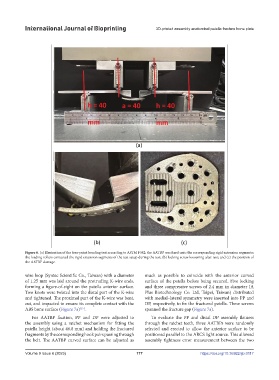
            Figure 6. (a) Illustration of the four-point bending test according to ASTM F382; the AATBP was fixed onto the corresponding rigid extension segments;
            the loading rollers contacted the rigid extension segments of the test setup during the test; (b) locking screw loosening after test; and (c) the position of
            the AATBP damage.

            wire loop (Syntec Scientific Co., Taiwan) with a diameter   much as possible to coincide with the anterior curved
            of 1.25 mm was laid around the protruding K-wire ends,   surface  of  the patella before being secured.  Five locking
            forming a figure-of-eight on the patella anterior surface.   and three compressive screws of 2.4 mm in diameter (A
            Two knots were twisted into the distal part of the K-wire   Plus Biotechnology Co. Ltd, Taipei, Taiwan) distributed
            and tightened. The proximal part of the K-wire was bent,   with medial–lateral symmetry were inserted into PP and
            cut, and impacted to ensure its complete contact with the   DP, respectively, to fix the fractured patella. These screws
                                   [15]
            ABS bone surface (Figure 7a) .                     spanned the fracture gap (Figure 7a).
               For AATBP fixation, PP and DP were adjusted to     To evaluate the PP and distal DP assembly flatness
            the assembly using a ratchet mechanism for fitting the   through the ratchet teeth, three AATBPs were randomly
            patella height (about 46.8 mm) and holding the fractured   selected and erected to allow the anterior surface to be
            fragments by the corresponding hook pairs passing through   positioned parallel to the ARCS light source. This allowed
            the belt. The AATBP curved surface can be adjusted as   assembly tightness error measurement between the two

            Volume 9 Issue 6 (2023)                        177                         https://doi.org/10.36922/ijb.0117

