


Page 181 - IJB-9-6
P. 181
International Journal of Bioprinting                    3D-printed assembly anatomical patella fracture bone plate


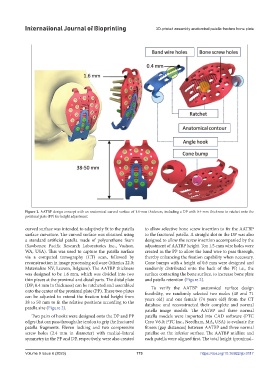
            Figure 2. AATBP design concept with an anatomical curved surface of 1.6-mm thickness, including a DP with 0.4-mm thickness to ratchet onto the
            proximal plate (PP) for height adjustment.

            curved surface was intended to adaptively fit to the patella   to allow selective bone screw insertion to fix the AATBP
            surface curvature. The curved surface was obtained using   to the fractured patella. A straight slot in the DP was also
            a standard artificial patella made of polyurethane foam   designed to allow the screw insertion accompanied by the
            (Sawbones;  Pacific  Research  Laboratories  Inc.,  Vashon,   adjustment of AATBP height. Ten 1.5-mm wire holes were
            WA, USA).  This was used  to capture  the patella surface   created in the PP to allow the band wire to pass through,
            via a computed tomography (CT) scan, followed by   thereby enhancing the fixation capability when necessary.
            reconstruction in image processing software (Mimics 22.0;   Cone bumps with a height of 0.6 mm were designed and
            Materialize NV, Leuven, Belgium). The AATBP thickness   randomly distributed onto the back of the PP, i.e., the
            was designed to be 1.6 mm, which was divided into two   surface contacting the bone surface, to increase bone plate
            thin pieces at the proximal and distal parts. The distal plate   and patella retention (Figure 2).
            (DP; 0.4 mm in thickness) can be ratcheted and assembled   To verify the AATBP anatomical surface design
            onto the center of the proximal plate (PP). These two plates   feasibility, we randomly selected two males (48 and 71
            can be adjusted to extend the fixation total height from   years old) and one female (74 years old) from the CT
            38 to 50 mm to fit the relative positions according to the   database and reconstructed their complete and normal
            patella size (Figure 2).                           patella image models. The AATBP and three normal
               Two pairs of hooks were designed onto the DP and PP   patella models were imported into CAD software (PTC
            edges that can pass through the tendon to grip the fractured   Creo V6.0; PTC Inc., Needham, MA, USA) to evaluate the
            patella fragments. Eleven locking and two compressive   fitness (gap distances) between AATBP and three normal
            screw  holes  (2.4  mm  in  diameter)  with  medial–lateral   patellae on the inferior surface. The AATBP midline and
            symmetry in the PP and DP, respectively, were also created   each patella were aligned first. The total height (proximal–


            Volume 9 Issue 6 (2023)                        173                         https://doi.org/10.36922/ijb.0117

