


Page 180 - IJB-9-6
P. 180
International Journal of Bioprinting                   3D-printed assembly anatomical patella fracture bone plate


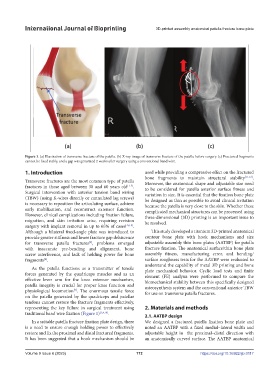
            Figure 1. (a) Illustration of transverse fracture of the patella. (b) X-ray image of transverse fracture of the patella before surgery. (c) Fractured fragments
            cannot be fixed stably, and a gap was generated 2 weeks after surgery using a conventional band wire.

            1. Introduction                                    used while providing a compressive effect on the fractured
                                                               bone fragments to maintain structural stability [11,12] .
            Transverse fractures are the most common type of patella   Moreover, the anatomical shape and adjustable size need
            fractures in those aged between 30 and 60 years old [1-5] .   to be considered for patella anterior surface fitness and
            Surgical intervention with anterior tension band wiring   variation in size. It is essential that the fixation bone plate
            (TBW) (using K-wires directly or cannulated lag screws)   be designed as thin as possible to avoid clinical irritation
            is necessary to reposition the articulating surface, achieve   because the patella is very close to the skin. Whether these
            early mobilization, and reconstruct extensor function.   complicated mechanical structures can be processed using
            However, clinical complications including fixation failure,   three-dimensional (3D) printing is an important issue to
            migration, and skin irritation arise, requiring revision   be resolved.
            surgery with implant removal in up to 65% of cases [4,6-8] .
            Although  a  bilateral  fixed-angle  plate  was  introduced  to   This study developed a titanium 3D-printed anatomical
            provide greater stiffness and lower fracture gap dehiscence   contour bone plate with hook mechanisms and size
            for transverse patella fractures , problems emerged   adjustable assembly thin bone plates (AATBP) for patella
                                       [3]
            with inaccurate pre-bending and alignment, bone    fracture fixation. The anatomical surface/thin bone plate
            screw interference, and lack of holding power for bone   assembly fitness, manufacturing error, and bending/
            fragments .                                        surface roughness tests for the AATBP were evaluated to
                    [4]
                                                               understand the capability of metal 3D printing and bone
               As the patella functions as a transmitter of tensile
            forces generated by the quadriceps muscles and as an   plate mechanical behavior. Cyclic load tests and finite
                                                               element (FE) analysis were performed to compare the
            effective  lever  arm  for  the  knee  extensor  mechanism,   biomechanical stability between this specifically designed
            patella integrity is crucial for proper knee function and   osteosynthesis system and the conventional anterior TBW
            physiological locomotion . The enormous tensile force   for use on transverse patella fractures.
                                [9]
            on the patella generated by the quadriceps and patellar
            tendons cannot restore the fracture fragments effectively,
            representing the key failure in surgical treatment using   2. Materials and methods
            traditional band wire fixation (Figure 1) [3,4,10] .
                                                               2.1. AATBP design
               In a suitable patella fracture fixation plate design, there   We designed a fractured patella fixation bone plate and
            is a need to ensure enough holding power to effectively   noted  an AATBP with a  fixed medial–lateral  width  and
            restore and fix the proximal and distal fractured fragments.   adjustable height in  the proximal–distal direction with
            It has been suggested that a hook mechanism should be   an anatomically curved surface. The AATBP anatomical


            Volume 9 Issue 6 (2023)                        172                         https://doi.org/10.36922/ijb.0117

