


Page 186 - IJB-9-6
P. 186
International Journal of Bioprinting                   3D-printed assembly anatomical patella fracture bone plate


            Table 2. Surface roughness measured positions for the AATBP and corresponding obtained results


             Sample 1                    4.135               5.960           5.454           3.323
             Sample 2                    4.427               5.495           4.438           3.545
             Sample 3                    4.698               5.325           6.264           3.824
             Mean ± Std (µm)             4.42 ± 0.28         5.59 ± 0.33     5.39 ± 0.91     3.56 ± 0.25
            Unit: µm


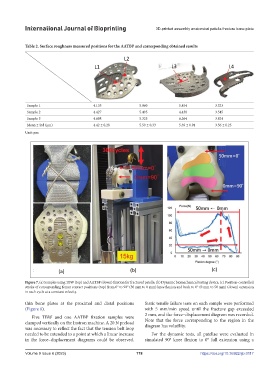
            Figure 7. (a) Samples using TBW (top) and AATBP (down) fixation for fractured patella. (b) Dynamic biomechanical testing device. (c) Position-controlled
            stroke of corresponding femur contact positions (top) from 0° to 90° (50 mm to 0 mm) knee flexion and back to 0° (0 mm to 50 mm) (down) extension
            in each cycle at a constant velocity.

            thin bone plates at the proximal and distal positions   Static tensile failure tests on each sample were performed
            (Figure 8).                                        with 5 mm/min speed until the fracture gap exceeded
               Five TBW and one AATBP fixation samples were    2 mm, and the force–displacement diagram was recorded.
            clamped vertically on the Instron machine. A 20 N preload   Note that the force corresponding to the region in the
            was necessary to reflect the fact that the tension belt loop   diagram has volatility.
            needed to be extended to a point at which a linear increase   For  the  dynamic tests,  all patellae  were  evaluated  in
            in the force–displacement diagrams could be observed.   simulated 90° knee flexion to 0° full extension using a


            Volume 9 Issue 6 (2023)                        178                         https://doi.org/10.36922/ijb.0117

