


Page 199 - IJB-9-6
P. 199
International Journal of Bioprinting                              Attractiveness of 4D printing in medical field


               Experts with an extensive background in 3D and 4D
            printing were contacted during the CTI cycle to request
            an assessment of the results, especially in the steps of
            information collection strategy, data collection, and
            information analysis. Their advice was used to eliminate
            unsuitable data and unrelated information. Furthermore,
            experts validated the reliability of the data obtained.


            4. Results and discussion

            4.1. Publication trends
            As mentioned before, 358 publications on 4D printing
            in the medical field were gathered from Scopus between
            January 1, 2017, and May 9, 2023. An analysis of the
            178 relevant publications was performed to obtain the
            publication trends in design factors and applications of 4D
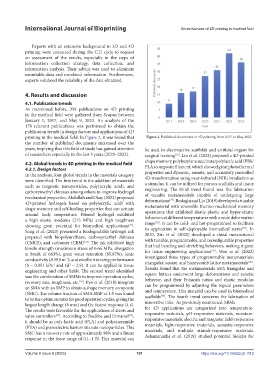
            printing in the medical field. In Figure 2, it was found that   Figure 2. Published documents in 4D printing from 2017 to May 2023.
            the number of published documents increased over the
            years, implying that this field of study has gained attention   be used in electroactive scaffolds and artificial organs for
            of researchers especially in the last 3 years (2020–2022).  surgical training . Lin et al. (2022) prepared a 4D-printed
                                                                            [36]
            4.2. Global trends in 4D printing in the medical field  shape memory polybutylene succinate/polylactic acid (PBS/
            4.2.1. Design factors                              PLA) composite filament, which showed great photothermal
            In the analysis, four global trends in the materials category   properties and dynamic, remote, and accurately controlled
            were identified. The first trend is the addition of materials   4D transformation using near-infrared (NIR) irradiation as
            such as magnetic nanoparticles, poly(acrylic acid), and   a stimulus. It can be utilized for porous scaffolds and tissue
            carboxymethyl chitosan among others to improve hydrogel   engineering. The third trend found was the fabrication
            mechanical properties. Abdullah and Okay (2023) proposed   of tunable metamaterials capable of undergoing large
                                                                         [37]
            4D-printed hydrogels based on poly(acrylic acid) with   deformations . Bodaghi and Lio (2019) developed a tunable
            shape memory and self-healing properties that can actuate   metamaterial with reversible thermo-mechanical memory
            around body temperature. Printed hydrogel exhibited   operations that exhibited elastic-plastic and hyper-elastic
            a high elastic modulus (215  MPa) and high toughness   behaviors at different temperatures with a wide deformation
                                                                   [38]
            showing great potential for biomedical applications .   range . It can be cold- and hot-programmed to facilitate
                                                        [33]
                                                                                                        [38]
            Song et al. (2023) presented a biodegradable hydrogel ink   its application in self-deployable biomedical stents . In
            prepared with biopolyurethane,  carboxymethyl  chitosan   2020, Xin  et  al. (2020) developed a chiral metamaterial
            (CMCS), and carbomer (CBM) . The ink exhibited high   with tunable, programmable, and reconfigurable properties
                                     [34]
            tensile strength (maximum stress of 0.66 MPa, elongation   that had bending and stretching behaviors, making it great
                                                                                           [39]
            at break of 643%), great water retention (85.87%), ionic   for tissue engineering applications . Wan  et al. (2022)
            conductivity (8.59 S m ), and excellent sensing performance   investigated three types of programmable metamaterials:
                             -1
                                                                                                           [40]
            (S = 0.051 kPa  and GF = 2.9). It can be applied in tissue   triangular, square, and honeycomb lattice metamaterials .
                        -1
            engineering and other fields. The second trend identified   Results found that the metamaterials with triangular and
            was the combination of SMMs to improve operation cycles,   square lattices underwent large deformations and auxetic
            recovery rate, toughness, etc. . Pyo et al. (2018) integrate   behavior, and their Poisson’s ratios and elastic modulus
                                   [34]
            an SMA with an SMP to obtain a shape memory composite   can be programmed by adjusting the topical parameters
            (SMC). The volume fraction of SMA:SMP of 1:5 was found   and temperature. This material can be used in biomedical
                                                                      [40]
            to be the optimum ratio for good operation cycles, giving the   scaffolds . The fourth trend concerns the fabrication of
            largest length change (8 mm) and the fastest response (4 s).   innovative inks.  As previously mentioned, SRMs
            The results were favorable for the applications of stents and   for 4D applications are categorized into temperature-
            valve controllers . According to Bodkhe and Ermanni ,   responsive materials, pH-responsive materials, moisture-
                         [35]
                                                        [36]
            it should be as poly-lactic acid (PLA) and polyesteramide   responsive materials, electric and magnetic field-responsive
            (PEA) and piezoelectric barium titanate nanoparticles. This   materials, light-responsive materials, acoustic-responsive
            SMC has a recovery rate of approximately 98% and a linear   materials,  and multiple stimuli-responsive materials.
            response in the force range of 0.1–1 N. This material can   Ashammakhi  et al. (2018) studied potential bioinks for
            Volume 9 Issue 6 (2023)                        191                         https://doi.org/10.36922/ijb.1112

