


Page 202 - IJB-9-6
P. 202
International Journal of Bioprinting                              Attractiveness of 4D printing in medical field


            Figure 3. (a) Diagram of stomatal response to temperature and
            (b) PNIPAM hydrogel network. (Adapted from Zu et al. (2022) )
                                                    [64]
                                                               Figure 4. Behavior of stent when exposed to temperature. (Adapted from
               In 2019, Melocchi et al. (2019) presented an expandable   Lin et al. (2020) )
                                                                         [65]
            device for gastric retention fabricated from pharmaceutical-
            grade poly(vinyl alcohol) that was designed to be ingested
            in a temporary compact shape, which then returns its
            original shape within 3 min after exposure to aqueous fluids
            at 37°C . Finally, when the device is expanded, the drug is
                  [63]
            released. Models containing allopurinol were fabricated by
            FDM or hot melt extrusion, and drug release was slowed
            down using Eudragit® RS/RL-based coatings . Zu et al.
                                                [63]
            (2022) elaborated a PNIPAM hydrogel capsule inspired by
            plant stomata using an extrusion-based printing method .
                                                        [64]
            The PNIPAM hydrogel responds to temperature in the same
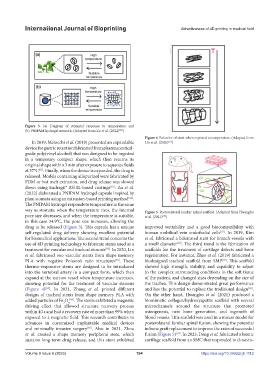
            way as stomata; when the temperature rises, the internal   Figure 5. Posterolateral lumbar spinal scaffold. (Adapted from Hwangbo
            pore size decreases, and when the temperature is suitable,   et al. (2021) )
                                                                      [70]
            in this case 34.9°C, the pore size increases, allowing the
            drug to be released (Figure 3). This capsule has a unique   improved wettability and a good biocompatibility with
                                                                                               [67]
            self-regulated drug delivery showing excellent potential   human umbilical vein endothelial cells . In 2019, Kim
            for biomedical applications. The second trend concerns the   et al. fabricated a bifurcated stent for branch vessels with
                                                                             [68]
            use of 4D printing technology to fabricate stents used as a   a small diameter . The third trend is the fabrication of
            treatment for vascular and tracheal stenosis . In 2020, Lin   scaffolds  for  the treatment  of cartilage  defects  and  bone
                                              [64]
            et al. fabricated two vascular stents from shape memory   regeneration. For instance, Zhao et al. (2019) fabricated a
            PLA with negative Poisson’s ratio structures . These   biodesigned tracheal scaffold from SMP . This scaffold
                                                                                                [69]
                                                  [65]
            thermo-responsive stents are designed to be introduced   showed  high  strength,  stability,  and  capability  to  adjust
            into the vertebral artery in a compact form, which then   to the complex surrounding conditions in the soft tissue
            expand at the narrow vessel when temperature increases,   of the patient, and changed sizes depending on the size of
            showing potential for the treatment of vascular stenosis   the trachea. This design demonstrated great performance
                                                                                                           [69]
            (Figure 4) . In 2021, Zhang  et al. printed different   and has the potential to replace the traditional design .
                    [65]
            designs of tracheal stents from shape memory PLA with   On the other hand, Hwangbo  et al. (2021) produced a
            added particles of Fe O 4 [66] . The stents exhibited a magnetic   biomimetic collagen/hydroxyapatite scaffold with several
                            3
            driving  effect  that  allowed  structure  recovery process   microchannels around the structure that promoted
            within 40 s and had a recovery rate of more than 99% when   osteogenesis, new bone generation, and ingrowth of
            exposed to a magnetic field. This research contributes to   blood vessels. This scaffold was used in a mouse model for
            advances in customized implantable medical devices   posterolateral lumbar spinal fusion, showing the potential
            and  minimally  invasive  surgery .  Also  in  2021,  Zhou   in bone graft replacement to improve the rates of successful
                                      [66]
            et  al. created a shape memory peripheral stent, which   fusion (Figure 5) . In 2023, Deng et al. fabricated a bionic
                                                                            [70]
            sustains long-term drug release, and this stent exhibited   cartilage scaffold from an SMC that responded to close-to-

            Volume 9 Issue 6 (2023)                        194                         https://doi.org/10.36922/ijb.1112

